


Weed bags are specifications, not merely printed pouches. A bag of aromatic flower does not serve exactly the same purpose as one that contains pre-rolls or infused edibles. The sensitivity of the product, the size of the portion, the way it opens, the retail regulations and the packing line influence what the final package should do.
The actual purchase decision starts with determination of the risks that may cause failure of the product or package. Next is format, then barrier, and finally dimensions, artwork and production testing. This order keeps a visually appealing bag out of the line that has too little seal-space, too much headspace or an inappropriate opening system.
Start With the Packed Product.
A supplier requires more than the category name. The first brief should explain the product in its entry form in the pouch and in the way the consumer will utilize it.
Record the product profile
● Product form, piece geometry and net weight
● Sensitivity to oxygen, moisture, aroma and light
● Presence of oil, sugar, crumbs or sharp edges
● Anticipated shelf life and climate of distribution.
● One-use or multi-use routine.
● Filling, sealing equipment and coding.
This information determines the actual packaging task. They also enable various suppliers to quote with the same assumptions rather than offering bags that appear similar but do various tasks.
Match the Bag Style to Its Use.
The most useful format will be the one that will be workable since the time it is filled up until the retail usage. Empty samples can be used to review print and construction; however the final dimensions must be approved using representative contents.

Flat pouches
Flat pouches occupy minimal storage area and suit pre-roll products or other slim contents. Customers must test access at the point of opening, clearance over the product and risk of the contents leaking into the heat-seal area.
Stand-up pouches


A bottom gusset provides stability of display and extra internal volume. This format may offer a general printable panel and allow it to be used repeatedly. Gusset depth, the position and volume of the zipper should be tested simultaneously, due to each other inducing a different pouch stance.
Bags that are larger in volume and gusseted on the side.
Side gussets have the ability to handle products that require further expansion or efficient case packing. Their folds and panels must be carefully placed in terms of artwork and the shape filled must be verified before the dimensions are presented.
Be Clear About Barrier Performance.

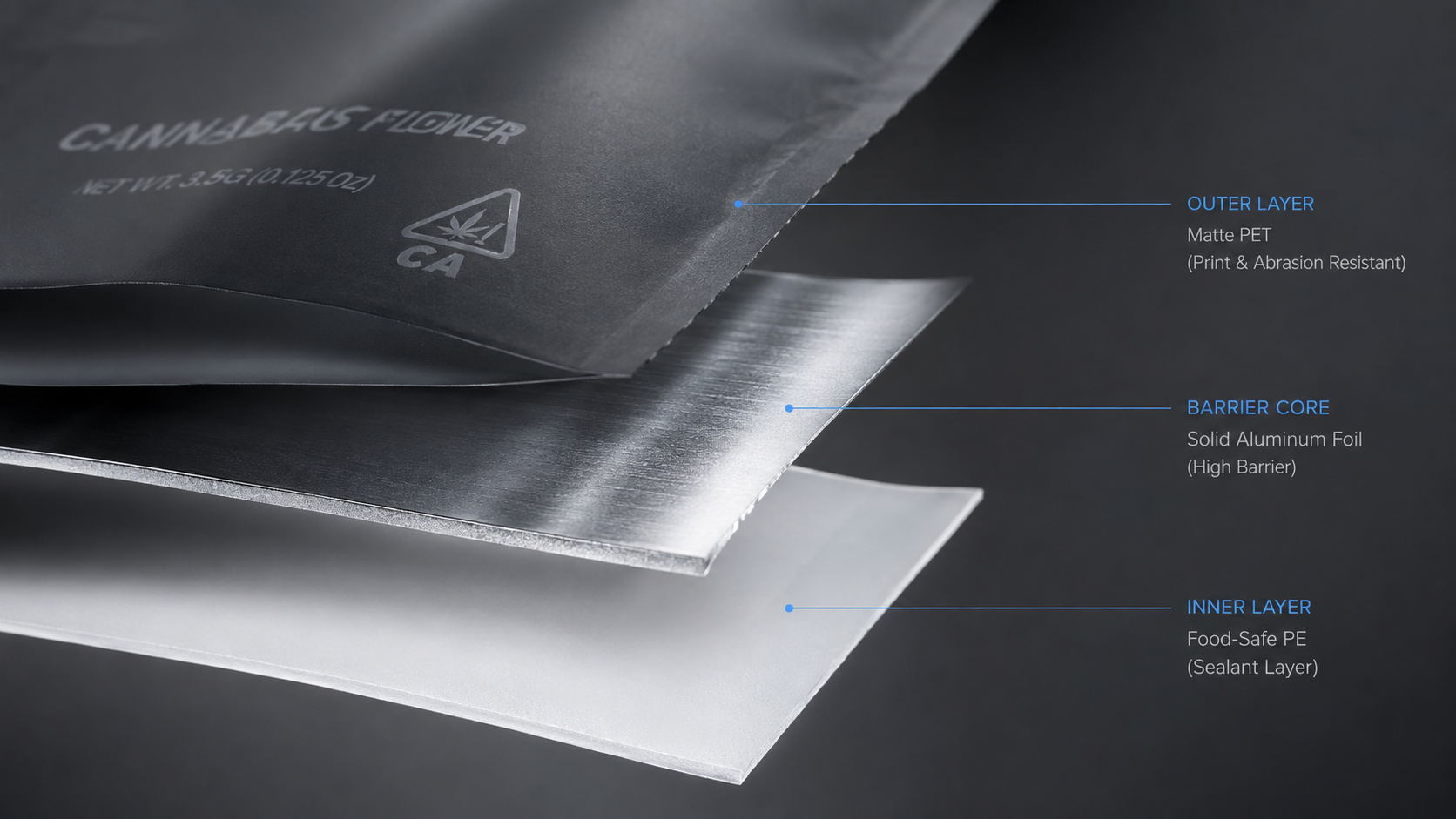
Mylar is not a term that entails a complete structure. Printable outer web, a barrier layer, adhesives and a food-contact sealant may be combined in weed bags. Laminates of varying types can thus be marketed with a similar commercial characterization but offer varying protection and conversion characteristics.
Rank the key exposure risk.
The most significant failure route of the product should be used to select a barrier. One product might be dominated by high aroma retention, whereas moisture control, light exclusion or grease resistance might dominate another.
● Headspace and seal quality should be controlled to contain exposure with the help of oxygen control but the film is also required to contain exposure.
● Protection against moisture conditions ought to indicate the product condition, storage climate, and shelf life desired.
● When quality is affected by light exposure, opaque or metallized layers might be necessary.
● The issue with puncture resistance is relevant when the rigid contents may damage the laminate when being handled.

The technical data of films is handy, and buyers ought to demand evidence of the converted pouch. Folds, seams, zippers and variation in production may affect finished performance.
Compare Heat Seal and Zipper.
The unopened pack is sealed with a heat seal. There is a zipper to allow reclosure once the top is taken off. A single treatment of them may expose an otherwise good pouch to vulnerability during initial opening or frequent usage.
Check the complete opening sequence
A filled-pouch trial is supposed to indicate that the adult is able to tear the package neatly, retrieve the product and completely reseal the zipper. Particles under 10 mm in diameter, track-side fragments or oils can alter the performance of closure.
● Check the width of the top-seal and the conditions of sealing.
● Keep the product clear of the seal and zipper tracks.
● Insert tear notches without harming important information.
● Check the closing following the anticipated number of openings.
Treat Child Resistance as a Market Requirement.
The use of child-resistant packaging is a performance system and not a visual system. The necessity of it and the evidence that can be used will vary, based on the type of product involved and the market to which it is destined. Before artwork and bulk production, the rules should be verified by the qualified compliance reviewer of the brand.
Build the requirement into the specification.
The purchasing brief must indicate whether the package has to be single-use or reclosable, the opening instructions required, any test documentation provided and what final configuration is to be provided. A size or structure that has been used successfully on another pouch does not necessarily justify a new one.
Determine Dimensions From Filled Volume.

Net weight alone cannot determine bag size. Equal-weight products can exhibit varying bulk density, shape and allowable compression. Overcapacity may cause unwanted headspace, unstable presentation, and undercapacity may pollute the seal area or overstretch the gusset.
Approve a representative filled sample.
The filled width, height and depth, necessary sealing clearance, final headspace, hand access and shipping cases number should be documented in dimension trials. The sample must also undergo the desired filling and sealing process without distorting the artwork or closure.
Book Artwork Space in Advance of Design Approval.
The printable surface should be branded and marketed but not critical content over seals, folds or tear lines. Artwork should be completed with a dieline indicating fixed structural areas.
● Allow space for warnings, symbols and net contents.
● Isolate permanent brand data as opposed to variable batch data.
● Confirm size, scanning and orientation of barcodes.
● Keep important copy away from gusset folds and edges.
● Compare all SKUs with the same information hierarchy.
This allows a product family to be scaled easier since common sections do not vary whereas flavor, strain or batch can alter within controlled sections.
Check the Finished Pouch prior to ordering.


The package should be converted and filled, and should not just be a flat film certificate or a digital artwork proof. The test plan is to replicate the pressures that the bag will undergo during packing, transport, storage and use.
Use production-relevant checks
● Perform filling runs and check seal cleanliness.
● Check leakage and post-handling seal.
● Repeat opening and reclosure tests.
● Evaluate drop, compression, abrasion and case packing.
● Confirm coding, barcode reading and registering artwork.
● Test packed samples after realistic storage conditions.
When there is a change in the composition of a product, its fill weight, dimensions or equipment settings, then the concerned checks must never be repeated on the assumption that they will have the same value.
Prepare Similar Supplier Quotations.
A dependable quotation refers to a single set commercial job. The same product, structure, printing, quantity and delivery assumptions should be sent to a supplier by the buyers.
Include the approval route
The request must include number of designs, quantity per SKU, finish required, sample required, documentation requirement, destination and target schedule of delivery. YPAK will then be able to negotiate on appropriate flexible formats, laminate options, printing techniques and production considerations with a more concise brief. Final performance and regulatory approval is attached to the product and market of the buyer.
Conclusion
Product protection, controlled access, production efficiency and retail communication in a single repeatable specification are attainable through effective weed bags. When choosing a pouch that is familiar looking and finding a solution to performance later, there is a greater likelihood of closing problems such as poor fit or missing evidence of approval.
An improved process begins with the product and allocates all risks to a packaging process and authenticates the completed pouch in real conditions. The resulting specification is simplified and easier to quote, approve and reorder with an increasing product range.
FAQ
What are weed bags used for?
They are versatile bags that are applied to products, including flower, pre-rolls and selected edibles. The right structure and closure will be according to the precise contents and market of destination.
Are the weed bags all smell-proof?
No. Retention of aroma is based on the entire laminate, seams, heat seal and closure. Finished-pouch performance cannot just be demonstrated by a product description.
Is Mylar a complete material specification?
No. It is usually adopted as a general business term. Buyers are to demand the complete laminate, sealant, thickness and performance information of the finished-pouch.
What is an ideal time to use a stand-up pouch?
It comes in handy when shelf life, larger printable panel or frequent access is needed. It should be tested with actual fill and its dimensions and gusset.
Should all weed bags be child-resistant?
Needs differ according to product and market. The responsible compliance reviewer should ensure that he or she identifies the rules and evidence required before making a purchase.
What ought to be endorsed prior to mass production?
Check through the dimensions, structure, closure, printing, seal conditions, artwork and representative filled-pouch test results prior to releasing the bulk order.
Post time: Aug-31-2026


