


Flat Bottom Matcha Bag Explained: Formats, Barriers and Best Uses
Flat Bottom Matcha Bag Explained: Formats, Barriers and Best Uses
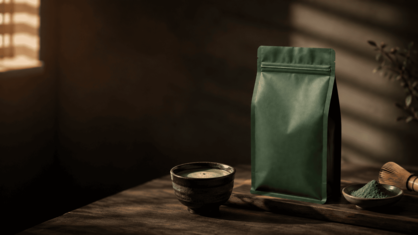
A flat bottom matcha bag offers a square shelf profile, wide opening and five printable panels. These characteristics can suit premium matcha and café refill packs, yet the shape is not sufficient to shield the powder. When filling, Matcha is oxygen sensitive, moisture sensitive, light sensitive, heat sensitive and dust sensitive.
Buyers shall order the pouch as a complete system: usable capacity, base geometry, laminate, food‑contact sealant, zipper, printing and filling process. It should be decided on a filled package that is protective of the intended matcha, reliable, and consistent in the production.
Learn the Flat‑Bottom Style
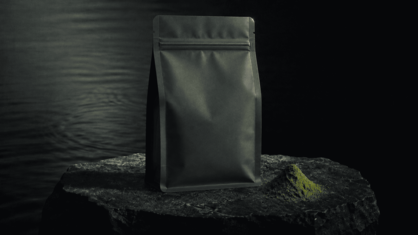
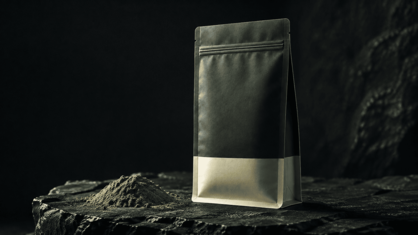
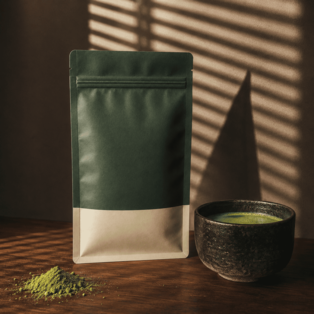
A flat‑bottom pouch is made with a known bottom panel and two side gussets to create a rectangle shape. It is able to provide a broader front face, and additional space to include preparation instructions, origin information, barcodes and variable coding as compared to a traditional stand‑up pouch.
Check Five Panels
- Product branding and main branding on front panel.
- Ingredients, instructions and information on back of package.
- Side gussets to hold copy to be readable, even after filling.
- Lower panel to record construction details or noncritical.
Accept dieline and a filled mock‑up due to folds and the bottom panel, which decrease the space that is left to see on shelf.
Size the Bag With Matcha Powder
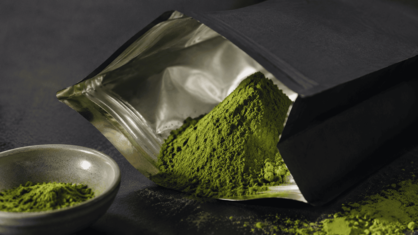
Milling, aeration, settling and formulation alter bulk density, hence the same net weight could take up varying volumes. The size of a pouch can thus vary between similar‑weight blends, latte powders and pure matcha even though these are labeled similarly.
Approve Usable Capacity
- Probe the minimum and maximum expected bulk density.
- Make sure that there is usable space below the zipper and above the bottom folds.
- Allow room to dose, seal cleaning and top sealing.
- Look at the settled appearance, and not at the newly filled shape.
Design the Base for Shelf Stability
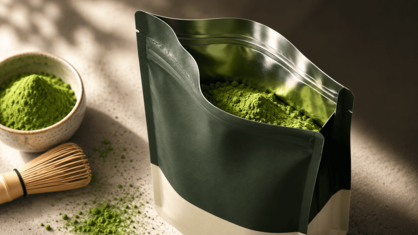
The bottom ought to be kept open and carry the centre of gravity of the material in the filled pouch. Excessive footprint can leave a significant portion of the fill collapsed on a light fill, whereas a narrow base can leave a tall and precarious package. Evaluation needs to be performed with width, gusset depth, bottom geometry and packed volume.
Test The Lowest Commercial Fill
Check rocking, leaning, corner collapse and panel distortion on the desired shelf. Perform a repeat of the assessment following case packing and simulated transport since compression may create creases on the base or may move the powder.
Specify Barrier Performance
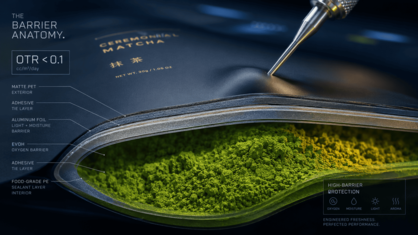
Matcha protection should take into consideration the oxygen, moisture and light during storage and repetition of use. Oxygen may impact on aroma and color; moisture may produce clumping; light and heat may speed quality deterioration. The barrier needed is based on the sensitivity of the products, the headspace, the climate, distribution, as well as shelf‑life target.
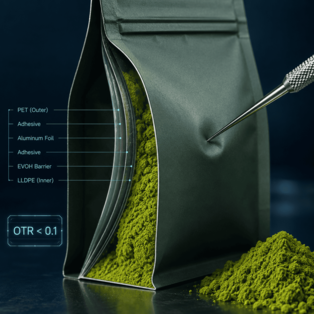
Order the Full Laminate
- Surface and outer web printable finish.
- Oxygen, moisture and light‑barrier.
- Food‑contact inner sealant and total thickness.
- Transmission data under stated test conditions.
Kraft, Mylar or foil look are all incomplete specifications. An opaque pouch can control light, but it does not prove the oxygen or moisture performance needed by the product.
Compare Conventional and Recyclable Structures
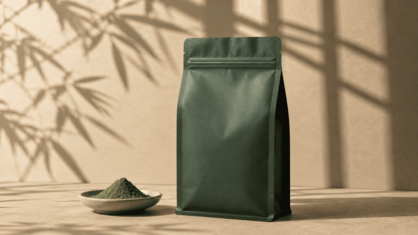
The conventional laminates have the ability to incorporate various materials in printing, barrier and sealing. Recyclable structures can be made of layers of the same polymer type but they could contain compatible barrier technology. YPAK offers customizable flat‑bottom design, as well as, traditional, recyclable and compostable material options.
Evaluate the Pouch Structure
- Barrier and stiffness at desired pouch size.
- Heat‑seal range and conformity with the filling line.
- Zipper, coatings, inks and any window that is clear.
- End‑of‑life claim in target market.
Manage the Seal and Zipper Area
The permanent seals are formed by the inner layer and are in direct contact with the powder. The fineness of the matcha powder can form channels when it is deposited on the seal region, and thus a thicker film cannot correct ineffective cleaning or an inappropriate sealant.
Record the Operating Window
- Seal temperature, pressure and dwell time.
- Seal width and top allowance are acceptable.
- Dust control before heat sealing.
- Leak, peel and visual acceptance criteria.
Verify Reclosure
Make sure that the tear line is not harming the zipper, the opening provides sufficient grip and that the zipper can be fastened back again after frequent use. Redo after transport conditioning of the actual powder in the pouch.
Coordinate the Pouch With Filling Equipment
Premade‑pouch equipment is required to automatically open, fill and release the five panel structure without damaging gussets or contaminating the top seal. Control dosing, settling and seal cleaning are required in the case of manual programs as well.
Run Plain Samples First
- Check trustworthy pouch opening and base expansion.
- Check dosing accuracy and dust extraction.
- Measure thickness, headspace and height.
- Check discharge, rejection and case‑packing performance.
Build Artwork Around the Filled Shape
Place important copy, fine lines and bar codes off of gusset folds, zipper seals, top seal, and bottom transitions. Lot and date coding require a predictable area to be filled in after filling.
Review Three Proof Stages
- Digital artwork proof for copy and version control.
- Printed‑film proof for color, substrate and finish.
- Converted filled sample of folds, registration and readability of codes.
YPAK lists digital and gravure printing capabilities. The printing path ought to include run size, SKU count, artwork stability and the repeat‑order strategy.
Compare Common Matcha Pouch Formats
Choose by Application and Validation
| Format | Typical strength | Main validation question |
|---|---|---|
| Flat bottom | Five printable and stable box profile. | Will the fill completely open and stabilize the base? |
| Stand‑up | Efficient curved footprint in numerous sizes of retail. | Does the bottom gusset expand without trapping powder? |
| Flat pouch | Compact material use for samples and small portions. | Does it have sufficient space in the opening and label? |
There is no universally most suitable format. Compare similar matcha fill in candidate pouches and choose the optimal balance of capacity, protection, line performance and material consumption.
Approve the Filled and Sealed Package
The desired powder, fill weight, laminate, zipper, printing and sealing conditions should be used as a final approval. Condition samples for the anticipated distribution climate and examine the product and the pouch.
Filled‑Pouch Approval Checklist
- Matcha color, aroma, taste and clumping.
- Seal cleanliness, strength and leakage.
- Base opening, shelf stability and completed dimensions.
- Alignment of zippers and closing again.
- Print registration, barcode readability and scuff resistance.
Freeze the Approved Specification
Record pouch style, size and tolerances; laminate layers and thickness; barrier target; food‑contact sealant; zipper and tear features; printing process; artwork revision; packing procedure; inspection requirements and change‑control requirements. Keep a sample of production reference and approved drawing.
Check any modification of the powder, fill weight, geometry, laminate, closure, printing route or filling equipment prior to release of a repeat order.
Incoming inspection should use the approved reference. Before filling: Compare delivered pouches for dimensions, materials used, quality of seals, positioning of zippers, registration and condition of print and packaging. This control is used to distinguish a supplier variation from a filling‑line issue in the manufacturing process.
Conclusion
It is imperative that a flat bottom matcha bag is picked on the basis of filled‑package evidence, instead of the way it looks on the shelf. The buyers must organize powder density, usable capacity, base stability, barrier, sealing, reclosure, filling and artwork. Production and repeat ordering are then easier to manage by means of a controlled specification.
FAQ
Can a flat bottom bag be used with matcha?
Yes, when its laminate, capacity, seals and base geometry have been validated with the desired powder and fill weight.
Does the format automatically provide a high barrier?
No. It is not the pouch shape that provides barrier performance but rather the entire laminate, seals and closure areas.
Will a recyclable pouch with a flat bottom keep matcha safe?
Potentially. The entire structure should fulfill the barrier and sealing standards of the product and should undergo filled‑pack and shelf‑life testing.
What should be included in an RFQ placed by a buyer?
Add the powder, bulk density, fill weight, shelf‑life objective, dimensions, barrier, closure, printing, filling procedure, amount, testing and delivery strategy.
Post time: Sep-05-2026


