


The look of a green powder is not more important than light proof matcha packaging. Even though a pouch may be sealed, retail lighting, daylight next to a window, exposure during storage may increase the speed of color and aroma changes. A package can thus contain oxygen and moisture and still be lacking a vital shelf‑life risk by allowing some of the product to be exposed to light.
The necessary level of the required opacity should be determined in the purchasing decision, the necessary material structure should be selected that preserves the required level of the required opacity even after conversion and the filled pouch should be tested in the conditions of real exposure. Dark art is not necessarily a sign of protection and a mere window of transparency can change the performance of a solid pack.
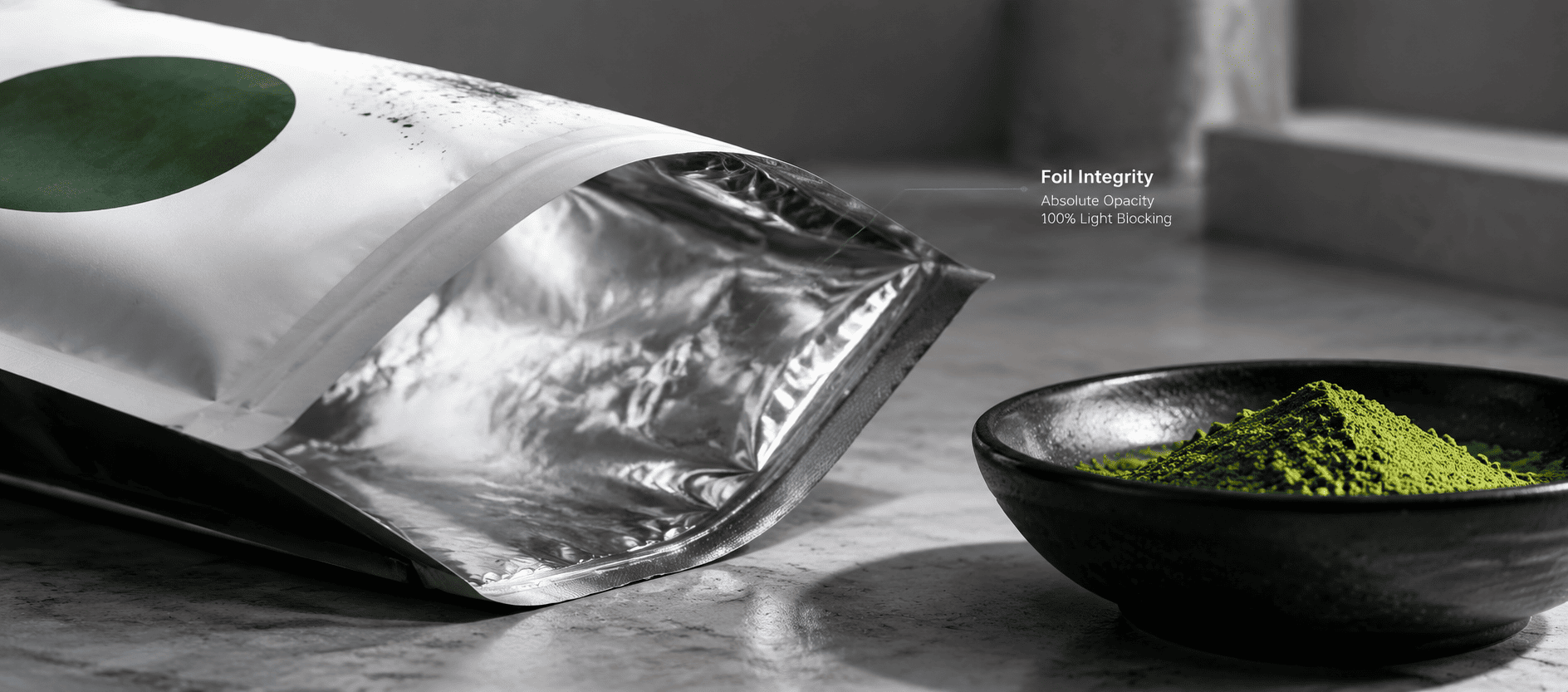
Understand the Light Exposure the Pouch Needs to endure.
Begin with the pathway that starts at filling and ends at consumption. Lighting in record warehouses, retail shelf life, volume to window and ecommerce sale of the product in an outer carton. The exposure to a cafe refill stored in a cabinet is different to that of a retail pouch stored in bright lights.
Relate Exposure to a Shelf‑Life Goal.
State the maximum amount of time of the unopened matcha that should maintain agreeable color and aroma. Add the post‑opening time during which the consumer can leave the pack on counter. These conditions provide the supplier and testing team with a definite target as opposed to the unspecified request of a dark bag.
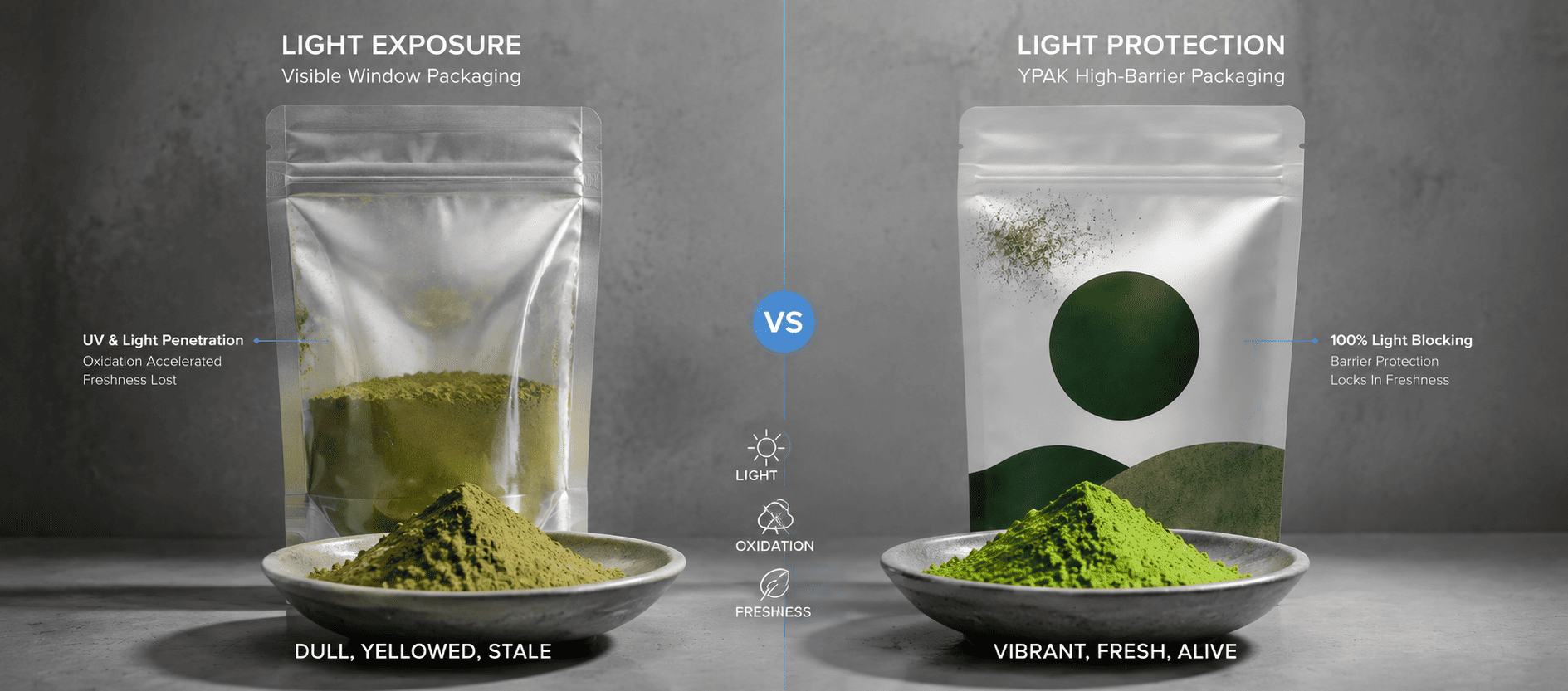
Differentiate between UV Protection and full opacity.
UV protection will cover a segment of the light spectrum whereas an opaque design will also restrict the light visible. The fact that a UV‑blocking clear film is transparent should not lead matcha buyers to believe that it offers the same protection as a completely opaque laminate. The appropriate requirement is based on the product, and exposure under control.
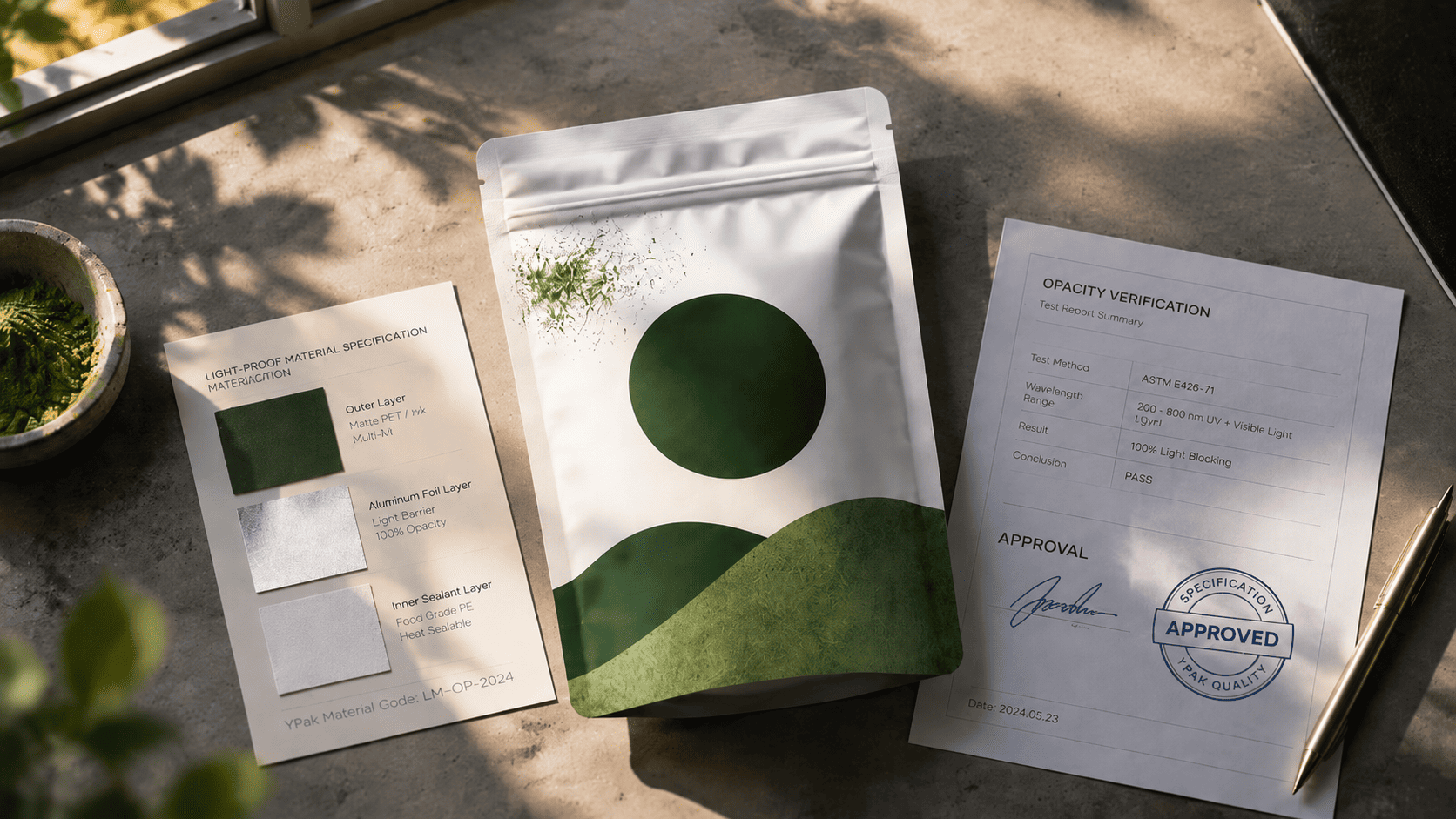
Enquire about what the supplier possibly means by light barrier, what layer will be providing it and whether the statement is applicable to the entire converted pouch. Color of the artwork, printed coverage and barrier construction should be outlined separately.
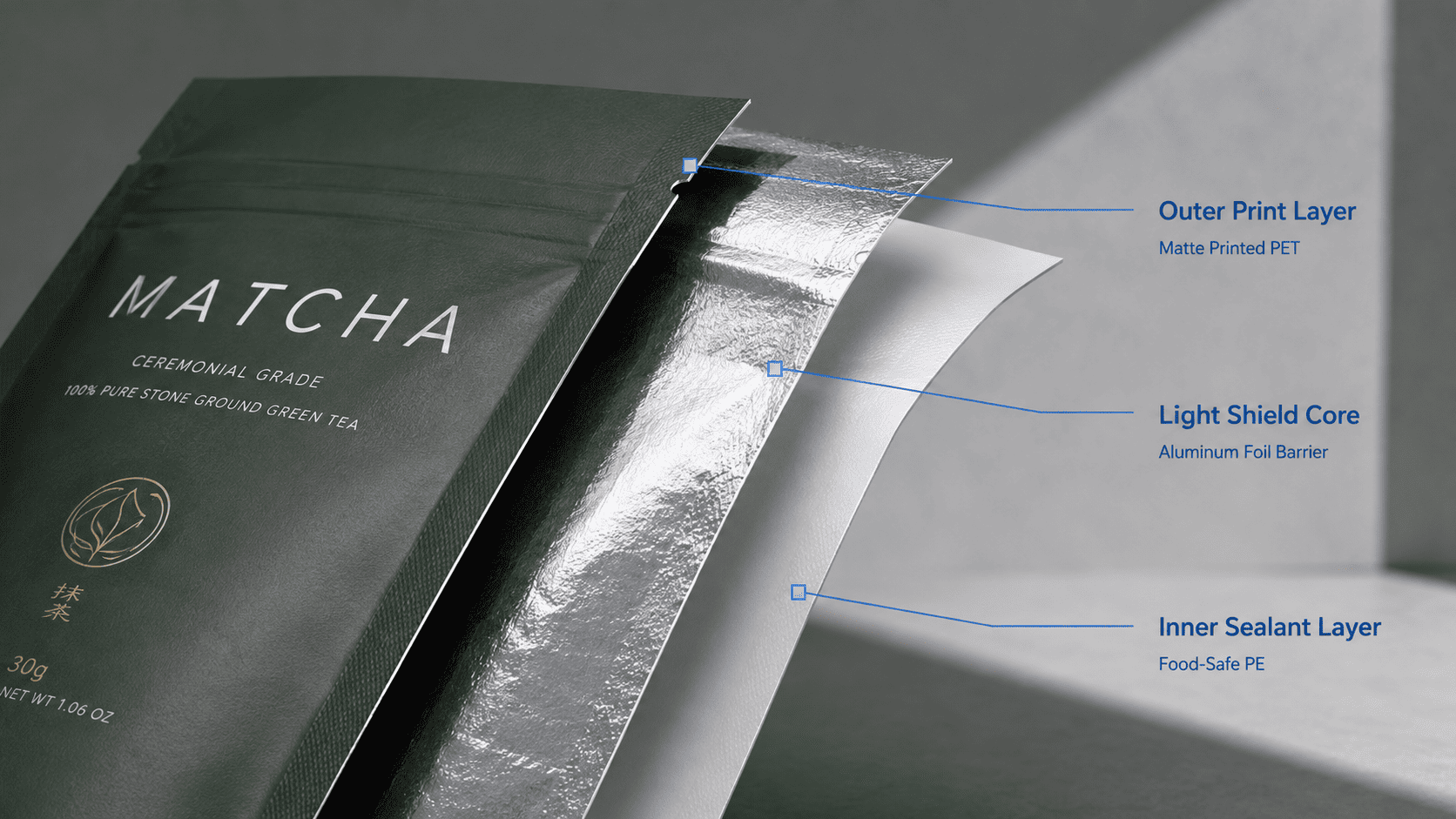
Use Foil in Complete Opacity as the Standard.
The use of aluminum foil is an established opaque‑barrier direction of sensitive powders. With the laminate and seals intact, it can withstand heavy loads with light, oxygen and moisture shielding. This renders foil applicable to high‑value matcha, long distribution routes or projects whose purchase specification is based on color retention.
Flex damage, stiffness and end‑of‑life constraints of the entire laminate should also be considered by the buyer. Test foil pouch after gusseting, filling, case packing and transport due to the folds or repeated handling that might cause weak areas that would not be seen in a flat film sample.
Compare Metallized Film with Opaque Alternative.
Alternatively, an opaque look and effective barrier properties can be obtained using metallized films with alternative flexibility, weight and cost profile. They can be applicable to retail programs which have multiple SKUs or brands which are interested in a balance between presentation and protection.
There is no single fixed specification of metallized. The quality of coating, film grade, lamination and conversion affect the results of the barrier and the results of the Opacity. Request the entire proposed structure and also test filled pouches in actual instead of believing the metallic look as evidence.
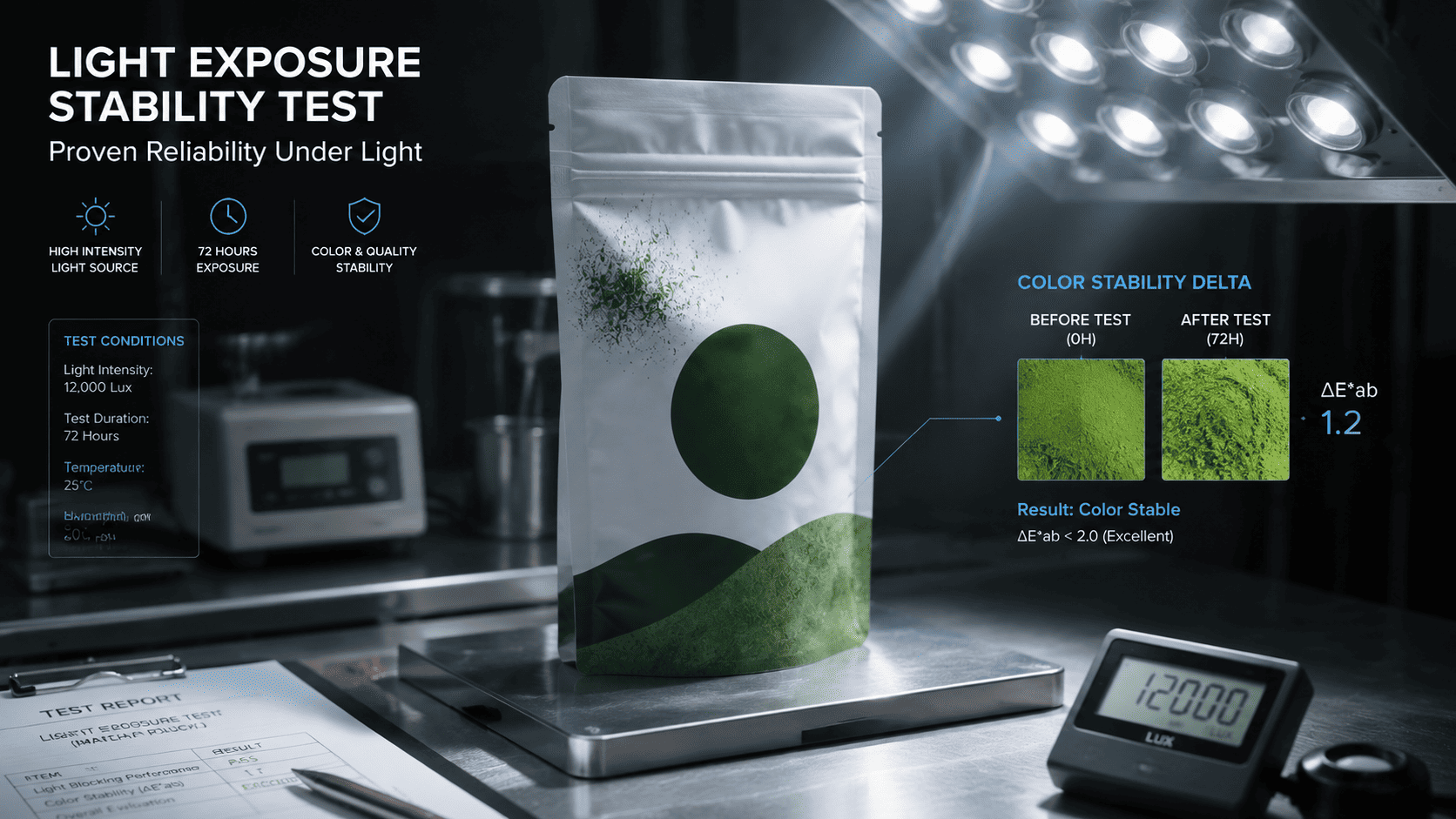
Check Opaque Recyclable Structures individually.
A direction made of a recyclable material can be made with pigments, coatings or barrier layers that can minimize light transmission. Both the environmental objective and the protection requirement ought to be approved. The required opacity is not created by a claim that is recyclable and the appearance of opaque does not create the claim.
Check Entire Pouch Claim.
Establish what is covered in the recycling statement in the pouch, such as zipper, valves, labels or coatings, as applicable. Check destination‑market advice and acquire the paperwork backing the wording. Shelf‑life, seal and light‑exposure tests are still required.
Use a Clear Window as a Controlled Weak point.
A window will enable the buyer to view the powder, but it will expose a specific area to light and can accumulate visible matcha dust during use. When visibility is a real commercial purpose, a window need not be larger than required, and should be located where the maximum exposure to light is not so great.
Do Not Accept the Window out of Artwork Only.
A computer mockup does not reveal the amount of product that is exposed, or what the window will appear like once it is filled. Take a converted sample with the desired powder. Test the visible, dusting, label legibility, color stability in the anticipated retail environment.
Equilibrium Opacity between Seals, Folds and Gussets.
The front panel is not the only place that is important. The structure may be creased or stretched by side seals, bottom gussets and folded corners. A pouch may seem opaque when un‑rolled, but demonstrate other behavior when rolled, loaded or pressed.
Stand‑up pouches, flat‑bottom bags and flat pouches ought to be considered in final geometry. YPAK provides the following types of tea packaging, however, the material and format must be agreed upon since each type of construction puts a dissimilar strain on the barrier.
Keep Printing Separate From the Barrier Decision.
A protected visual identity can be strengthened with dark green, black or metallic printing, however to cover ink is not a replacement to a specified light barrier. Printing can be different in folds, registration areas and areas that are not printed. The laminate must offer the necessary protection without the need to decorate other than what the test results would reveal.
Check Special Finishes on Filled Pouches.
Contrast can be influenced by matte, soft‑touch and metallic finishes; scuff resistance and code readability. Check the completed pouch following rubbing and handling case. Barcodes, batch codes and product information required should be legible without creating clear spaces undermining the protection goal.
Develop Practical Light‑Exposure Test.
The test ought to identify packages of the same matcha and control sample of the candidate. Exposure time on record, source of light, distance, temperature and areas of the pouch exposed. Maintain other variables constant to be able to relate a color or aroma change to the difference in packaging.
Apply Standardized Assessment.
An effective test record can consist of:
- Preliminary and final visual color determination in controlled lighting.
- Smell appraisal with the identical opening and sampling protocol.
- Photographs made under fixed conditions of camera and lighting.
- Comparison of front, back, folds and any transparent window.
- Check of seal, zipper and barrier post‑exposure.
- Post‑planned warehouse/retail exposure results.
When the brand has access to appropriate equipment, instrumental color measurement is able to give a stronger comparison. It must be documented in advance of the evaluation of the samples.
Test Light + Heat and Oxygen.
Retail light does not play alone. Display conditions can also increase the package temperatures and the presence of oxygen in the headspace could increase quality change. Compare pouches that are filled to the same degree, sealing and headspace control to ensure that the test does not confound multiple variables that are uncontrolled.
In case of nitrogen flushing, note residual oxygen in the samples under test. An enhanced light barrier can still give an insignificant outcome in case of excess oxygen trapped in the pouch or the seal made permanent is leaked.
Pass Reproducible Opacity Specification.
Purchase specification must point out the entire material structure, type of pouch, size, size of window in use, print coverage and authorized sample. Associate these facts with the shelf‑life goal and light‑exposure test outcome.
Retesting: Retesting is performed when the laminate, supplier, pigments, coating, window, pouch geometry or what the retailer wants to see changes. Repeat orders are supposed to reproduce the approved protection and not a description of color e.g. opaque green or metallic silver.
Conclusion
High‑quality light proof matcha packages utilize specified exposure environments, confirmed opaqueness and converted pouch that ensures protection throughout panels, folds and closures. Each of the foil, metallized and opaque recyclable structures can be taken into account when compared with the same matcha and shelf‑life target. Clearly separated windows need their own justification and validation.
FAQ
Is dark printing a matcha pouch light proof?
Not automatically. The color of artworks is not the same as a given barrier layer. Test the printed and converted pouch of the pouch as a whole under the exposure desired.
Does matcha have to be UV‑resistant clear film?
It can minimize some of the UV exposure but not as much as complete opacity. The requirement should be based on the product and shelf‑life target.
Is it possible to have a light‑proof matcha pouch with a window?
It can but the window is a controlled exposure area. Make it as small as possible and test the filled pouch in the standard retail environment.
What areas of the pouches are to be examined regarding their being opaque?
Front and back panels, gussets, folds, seals, corners and any window that has been filled and handled after the pouch has been filled.
How often to repeat light‑protection testing?
Repeat testing in the case of a change in material, supplier, coating, pigment, window, pouch format or anticipated storage and display conditions.
Post time: Aug-25-2026


