


Matcha packaging material must keep a fine powder that its quality may vary before a pouch appears spoiled. The color and smell of the green can be dulled by oxygen, moisture promotes clumping, light hastens decomposition, and heat enhances the action of the rest of the exposures. The choice of materials is thus a part of the product specification, not solely to the artwork brief.
An effective structure should also close on the equipment intended, must withstand powder around the fill zone, should have readable printing and should also be consistent between repeat orders. Buyers ought to not to choose a film according to one name of the material but to compare the complete laminates and converted pouches.
H2: Transfer Matcha Sensitivity to Material Requirements.
The initial discussion of the material should specify what the package needs to be resistant to and how long. Ceremonial matcha (pure) and culinary powder and flavored blends can contain varying levels of moisture, particle behavior and shelf-life performance. The protection level also varies depending on pack size, distribution temperature and time of opening and consumption.
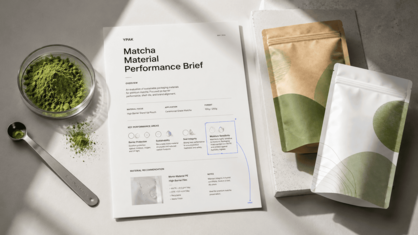
Assemble a Material Performance Brief.
Provide the supplier of packaging with the terms which are testable. The brief ought to comprise:
- · Formulation of products, grade and predicted moisture sensitivity.
- · Net weight, fill volume and opening frequency.
- · Shelf-life target and anticipated shelf-life.
- · Warehouse, export and retail exposure.
- · Planning temperature, equipment sealing and nitrogen-flushing.
- · Claim of required recycling, composting or disposal.
Such information enables two buildings to be listed against the identical job. In their absence, a low and a premium quote can be the same level of protection.
H2: Learn the Jobs in a Laminate.
Multi-layered flexible matcha packaging is a typical combination of multiple layers. The outer layer helps in printing, stiffness and handling resistance. An intermediate layer offers protection against oxygen, moisture or light. The heat seal is formed by the inner sealant that comes in contact with the food. These functions are linked into a single web with adhesives and coatings.
Thickness is not necessarily strength of a barrier, and a very protective coating is not necessarily one to use on all filling lines. The choice of layer, the compatibility of seals, flex resistance, and conversion quality all impact the finished pouch.
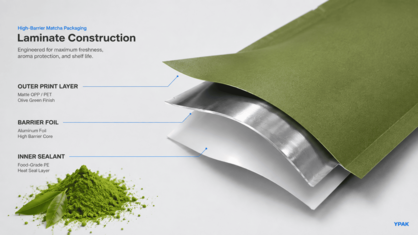
Outer Protection Layer and Print.
The outside web should contain the system of printing chosen and safeguard the artwork against rubbing, folding and transportation. PET and other printable films find application in cases where clarity, stiffness or surface life is needed. After conversion, matte, soft-touch and metallic effects are to be considered as finishes may alter the scuff resistance and code contrast.
Food-Contact Sealant Layer
The inner layer should be food contact-appropriate and be able to seal within the working range of the packing machine. It must also have a sufficient contamination tolerance of a fine powder. Buyers ought to verify the type of sealant, intended sealing range and supporting food-contact supporting documentation to the target market.
H2: Compare Direction of Common Barriers.
The choice of materials is to be regarded as construction guidelines, rather than categorizations. The following table indicates the way a buyer can initiate the comparison prior to trials. The actual matcha, pouch and production line are yet to be approved.
| Material direction | Main strength | Important tradeoff | Approval focus |
| Foil laminate | Benchmark high barrier and high opacities. | Flex damage and end-of-life limits, stiffness. | Integrity of converted-pouch after handling. |
| Metallized laminate | Opaque barrier having alternative flexibility and cost profile. | There are variations in performance by film and conversion. | Barrier information and shelf-life test. |
| Clear high-barrier film | Product visibility | Reduced light protection | Retail-light and color-stability test. |
| Recycling structure or compostable structure. | Promotes an environmental goal. | Both claim and barrier need to be checked. | Seal, shelf life and claim documentation. |
H 2: Use Foil In Case it Matters about the greatest opacity.
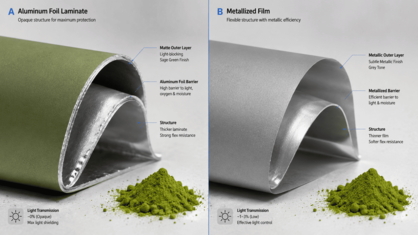
Another common standard in sensitive powders is aluminum-foil laminates due to the good oxygen and moisture resistance and high transparency of foil in cases when the laminate and seals are intact. It may be suitable to long distribution routes, hard shelf-life goals or high-end matcha the color of which is essential.
Tradeoffs are also presented by Foil. Flexing can cause damage, the structure might become stiffer and recycling possibilities are based on the complete laminate and local system. Approval of foil based on laboratory film values should not be made on the basis of a test but on the basis of a test of converted pouches filled, handled and transported.
H 2: Assess Metallized Film as a Balanced Structure.
The alternative cost, weight and flexibility profile of foil can be offered by metallized films that can offer the same level of opacity and useful barrier performance. They are usually the favored choice when a brand requires a robust protection of its products but does not want to use a foil laminate on each SKU.
Metallized is not used to characterize a single performance level. The result is affected by film grade, coating quality, lamination, folds and seal integrity. Request the full proposed structure and barrier information, and test it by testing shelf-life and filled-pouch under the conditions of the proposed distribution.
H2: Use Clear Films and Windows as Exposure Decisions.
The powder can be viewed on a clear film, but the visibility is counterproductory to light protection. During the use of matcha dust can also cause a window to appear untidy. When a transparent space is of commercial significance, only make it as large as it has to be and verify the completed pack in the actual retail lighting.
Adding a window to what has already been approved as a main barrier should not be added without a further review. Its location, weight and structure vary to change the protective mechanism. A product with a high color sensitivity is typically simpler to justify a fully opaque pouch.
H2: Read Recyclable and Compostable Material Claims.
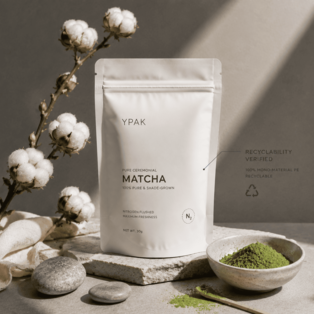
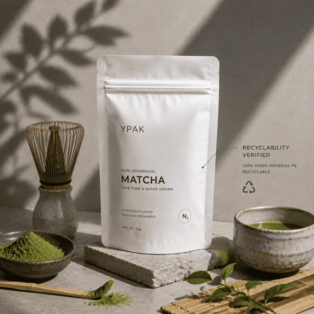
YPAK offers recyclable and compostable packaging, in addition to traditional flexible packaging. Such guidelines can back a brand purpose, yet the argument and the product-defense necessity ought to be considered collectively. The fact that its end-of-life message is attractive does not mean that a
Compare Like With Like.
Matcha, fill weight, pouch size, headspace, closure and shelf-life target Test candidate structures are the same. Establish what elements of the completed pouch the environmental statement is declaring, the way the pack is to be discarded and the market the pack is going to will accept the wording. The sustainability decision includes protection, which will not allow the waste of the product.
H2: Pair the Content with the Pouch.
Stand-up pouches, flat-bottom bags and flat pouches impose various mechanical stresses on a laminate. The bottom folds and gussets should be able to open without cracking the barrier. A flat-bottom structure requires sufficient stiffness to support its form whereas a smaller flat pouch might focus on barrier and carton functionality.
These are formats that YPAK provides to pack tea but format and material are to be accepted jointly. Essentially a laminate that works well as a plain flat sample might not work in the same way once gusseted, with the addition of a zipper, and flexed repeatedly.
H2: Matcha Present Check Seal Performance.
A pouch having a contaminated or a weak seal cannot be shielded by barrier data. During filling, matcha can fill the heat-seal area and zipper track. The inner material must be able to seal securely inside the equipment settings whereas the filling process must ensure that powder does not exceed the permanent seal.
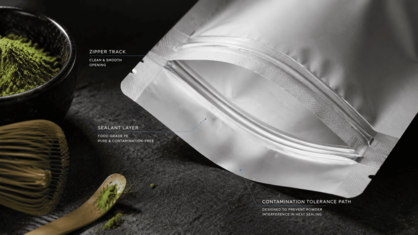
Use converted samples to determine seal temperature, pressure and dwell time. Check channels, post compression wrinkles and powder contamination. With resealable packs, zip it up and down with the product inside and ensure the permanent top seal and reclosure are functioning properly in their respective duties.
H2: Seek Evidence Prior to Material Approval.
There should be more than a generic description of the film in a supplier quotation. Please request: before material is approved:
- · The nominal thickness and the entire layer structure.
- · The role that each layer plays.
- · Relevant test conditions and data of oxygen and moisture barriers.
- · Food-contact records of the concerned market.
- · Seal suggestions and suitability with the filling technique.
- · Evidence in support of recyclable or compostable statements, where used.
These entries are to be associated with the validated pouch sizes, alterations and modifications of closures and artwork. They give a controlled reference when the brand rearranges or makes a comparison of a proposed material change.
H2: Test the Converted and Filled pouch.
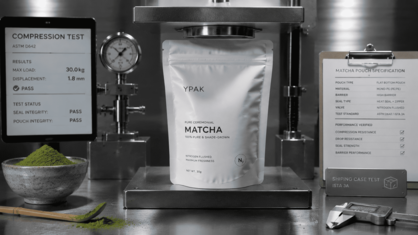
Real package should be the last stage in the approval of material. Fill and seal converted pouches with matcha and production settings desired. Check appearance, residual headspace, seal integrity, zipper functioning, light exposure, reading and shipping-case performance of codes.
Store accepted samples and test results. Should there be any change in the laminate, adhesive, sealant, pouch size, sealant, closure, fill weight or manufacturing equipment, repeat the corresponding evaluation. Even a seemingly trivial material replacement can alter sealing or shelf-life performance.
H2: Conclusion
An approved structure is the appropriate matcha packaging material and not a single film name. Buyers ought to relate product sensitivity to the outside print layer, barrier layer, food-contact sealant, pouch format and filling process. When the tradeoffs of foil, metallized, clear, and lower-impact structures are put to test, each has its place, in a converted, filled and sealed pouch.
H2: FAQ
Which are the most important barrier properties of matcha packaging?
Central to the finished result are oxygen, moisture and light protection, with issues of heat exposure, seal integrity and headspace control being secondary.
Does matcha powder need to be covered by aluminum foil?
No. Foil is an excellent opaque-barrier standard, yet when compared to the identical product, shelf life and distribution conditions, a metallized or other structure can achieve the target.
Do you think that recycling material is sufficient to offer matcha a barrier?
Depending on target and structure it may. Authenticate barrier data, sealing performance and shelf-life outcomes and the precise environmental claim prior to approval.
Why do you have to specify the inner layer?
The matcha is in contact with the inner layer which forms the seal of heat. It should be food-contact appropriate and in line with the conditions of production equipment and contamination.
What is the time interval of retesting a packaging material?
Retesting is done when there is a change in structure, supplier, pouch format, closure, size, product, fill weight, equipment or the shelf life required.
Post time: Aug-20-2026


