


More than air coming in through an open zipper should be controlled by an oxygen barrier pouch of matcha. The packaging film can allow oxygen to pass through, can be left in the headspace following the filling or can enter via an imperfect seal. All routes influence color, aroma and shelf‑life performance and a purchaser needs to specify the entire packaging system instead of asking to be provided with a bag that is airtight.
The question that is useful to purchase is the amount of oxygen that the finished pouch will expose the product to in the life it is supposed to last. The information of the materials, size of the pouches, method of filling, remaining oxygen and quality of the seal should be checked simultaneously. When the transmission of a flat film is low, it does not necessarily indicate that the same effect will be achieved when a converted, filled and repeatedly handled pouch is used.
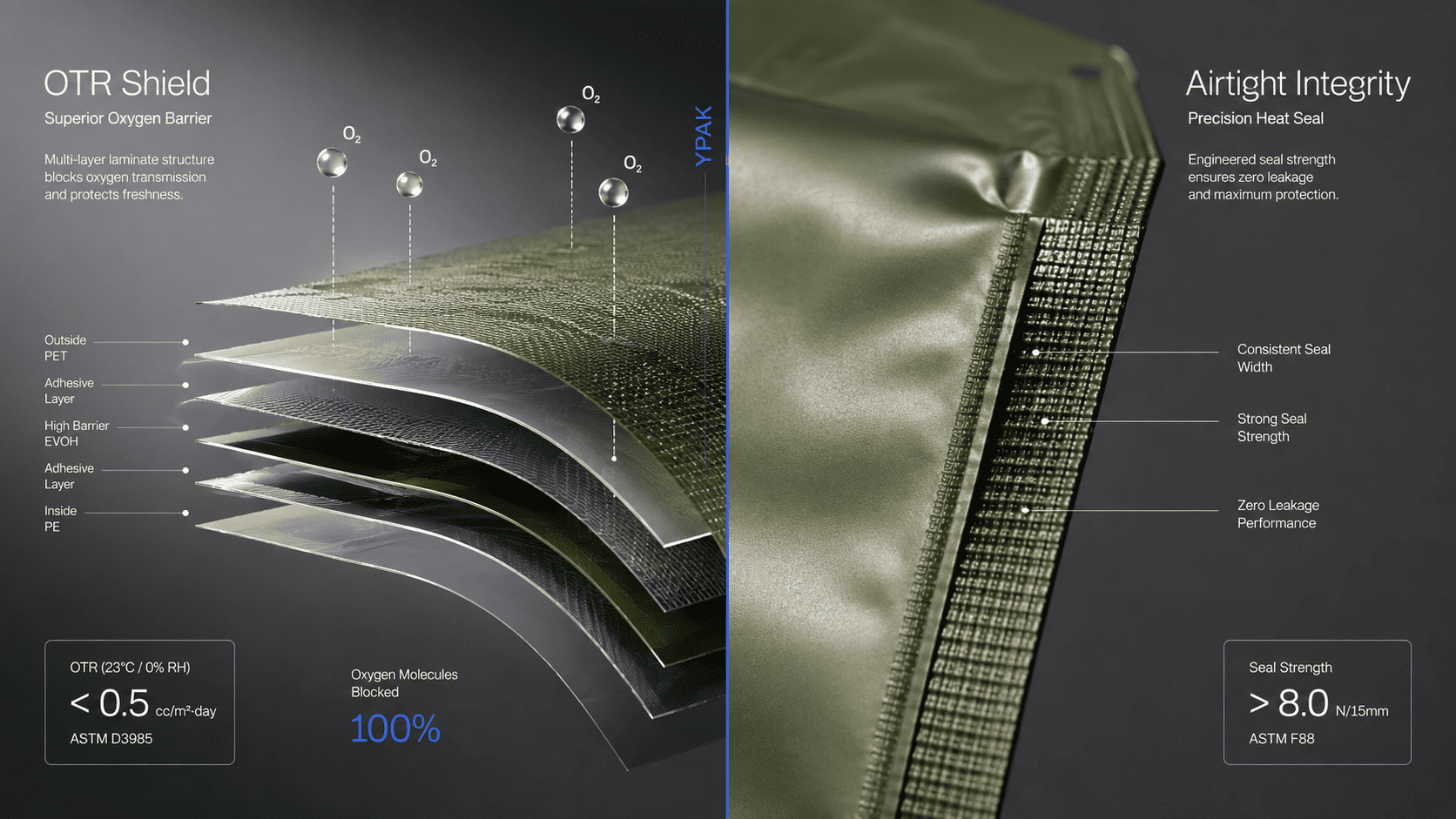
Stabilize the Matcha and Its Oxygen‑Control Target.
Start with grade, fill weight, anticipated shelf life and route of distribution. The oxygen history of a small ceremony matcha pouch that has been opened often is different than a food‑service refill in a sealed pouch or an ecommerce pack sealed in a carton. At the end of the planned period, the target ought to explain what can be acceptable in terms of color and aroma.
Document the Conditions behind the Target.
The temperature of document storage, humidity, durability of time to be sold and the anticipated period of opening. Find out whether the product will be nitrogen flushed, packed with an absorber or whether it will be put in secondary packaging. These facts enable the suppliers to match the structures with a single given job.
Film Permeation vs. Package Leakage.
Material properties are Oxygen transmission through a film where the stated conditions are taken. Leakage is a hole or a weak area due to seals, folds, contamination, zipper installation or a physical damage. A strong barrier film can be used in a package and it would still perform poorly when matcha powder gets in the heat‑seal region.
Request the evidence on both levels. Film data is used to select materials, and the testing of the converted structure is done by finished‑pouch testing. This is important as gussets, corners and closure elements are not present in a flat specimen of laboratory film.
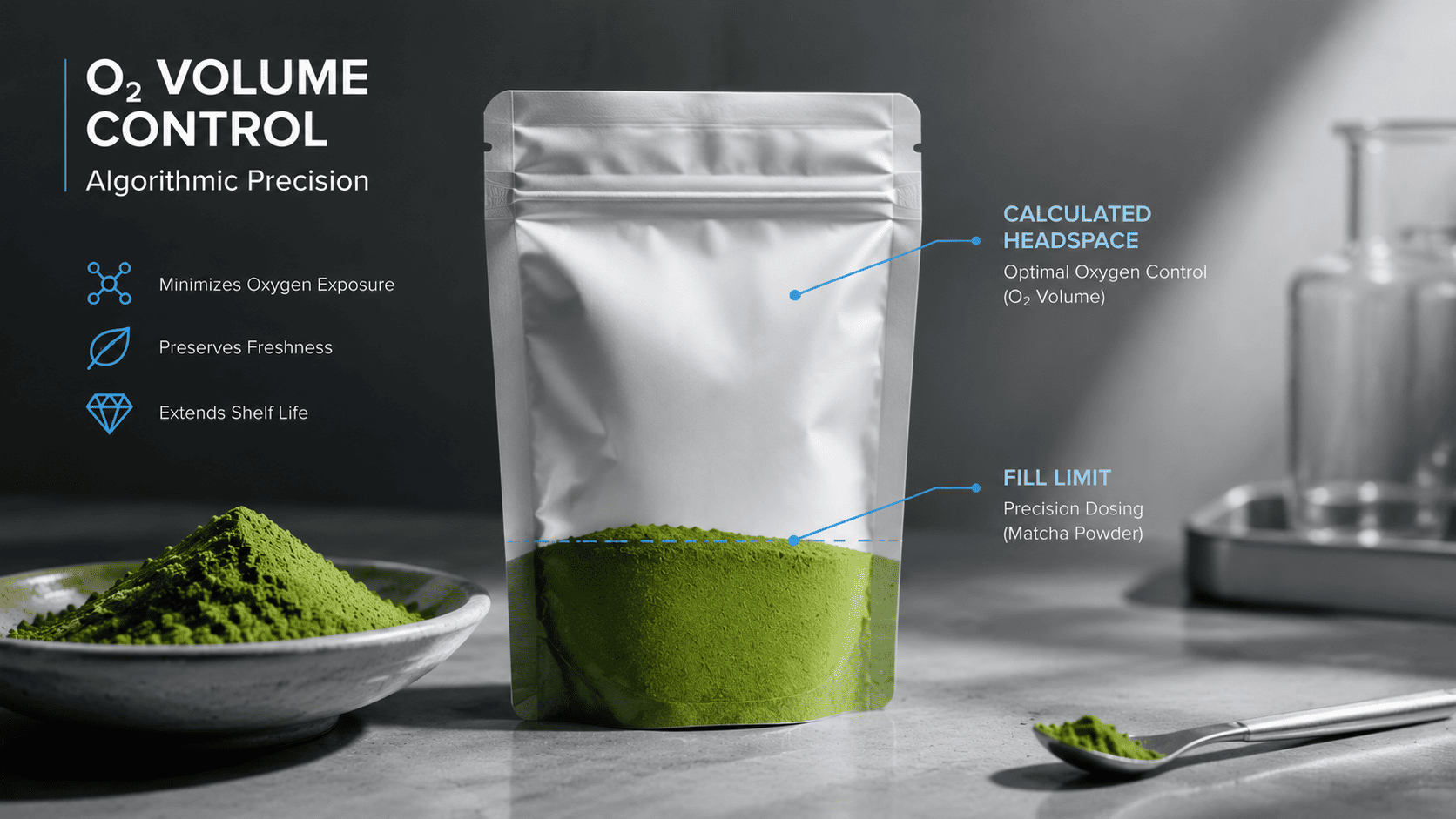
Read OTR Data Under its Test Conditions.
Oxygen Transmission rate or OTR, refers to the quantity of oxygen carried by a substance in a given area and at a given time. A small value typically signifies increased resistance, although the value only has significance in combination with its unit, temperature, relative humidity, specimen construction and test method.
Do not Compare Numbers which do not match.
Do not compare the value of a supplier on a complete laminate with that of a supplier on a single layer. Verify that the data is applicable to the printing, lamination and conversion. When this is not the case, ask to be tested under a standard protocol and not the lowest looking number.
Compare Material Directions on the Control of Oxygen.
The table offers a buying framework as opposed to universal performance rankings. Real data is determined by the layer grades, thickness, lamination quality, pouch conversion and test conditions.
| Material direction | Main strength | Issue to verify | Suitable purchasing context |
| Aluminum foil laminate | Demanding oxygen‑barrier benchmark | Flex damage, seals and complete laminate disposal. | High quality or long shelf‑life matcha. |
| Metallized laminate | Presentation and cost / balance of barrier. | Coating and conversion consistency. | Retail and multi‑SKU programs which are mainstream. |
| EVOH‑based structure | High‑barrier recyclable direction | Humidity, protection of the layer and market claim. | Companies that integrate protection and recycling objectives. |
| Clear basic film | Product visibility | Barrier lacks may be insufficiently enhanced. | Where evidence of shelf‑life is test evidence. |
Use Aluminum Foil as a Demanding Barrier Benchmark.
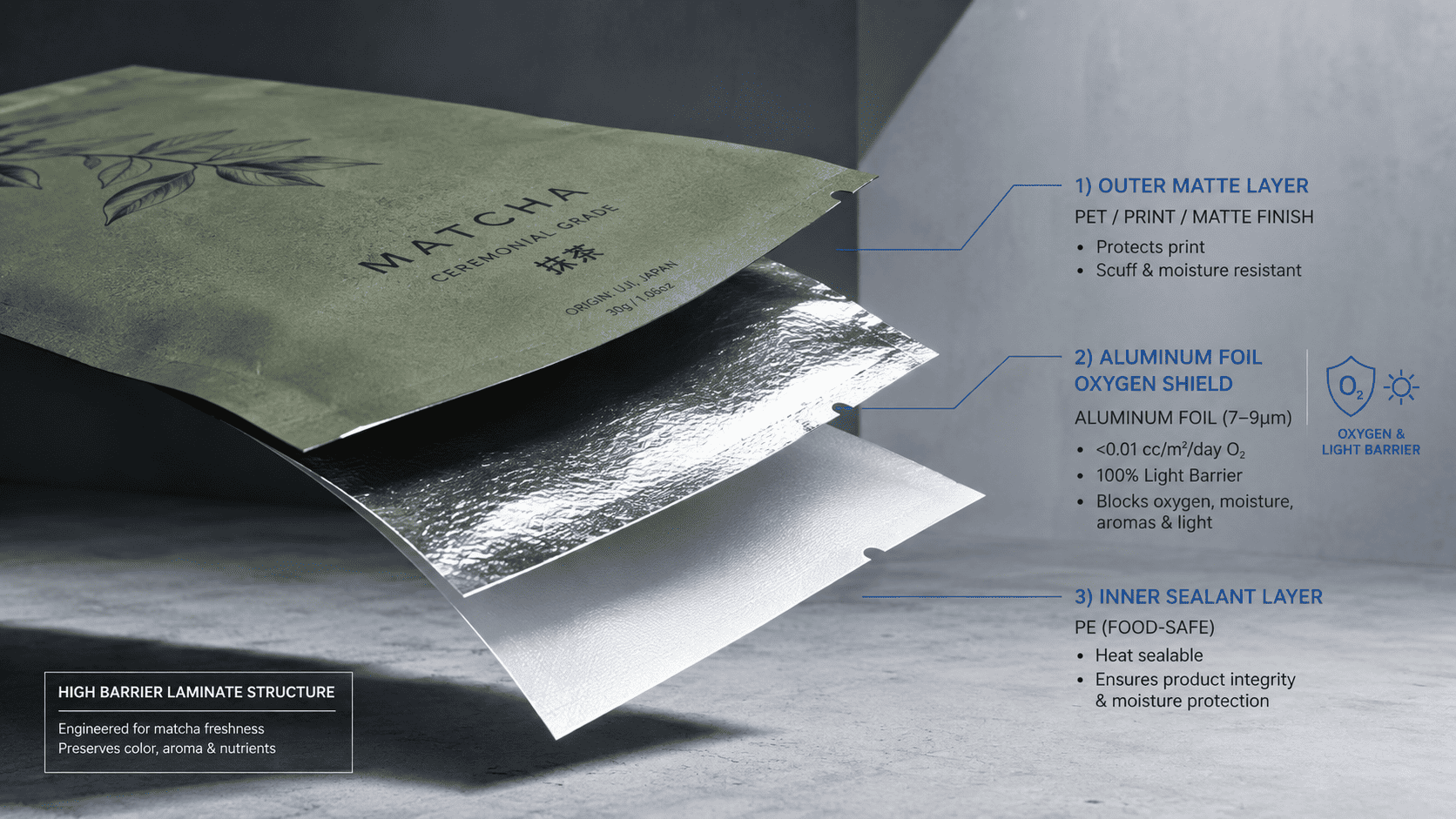
A common direction is an aluminum‑foil laminate that is used to store sensitive powders that need an intense level of oxygen, moisture and light preservation. It can be applicable in high end matcha, long distribution or long‑term projects that involve a high commercial penalty in small quality variations.
Foil is not exempt to damage of production. Acute folds, recurrent flexing and bad conversion may result in weak points. Accept the finished pouch following filling and distribution simulation and not just the material specification. The entire laminate must also have an end‑of‑life evaluation that suits the market it is going to.
Compare Metallized Film as a Compromise.
Metallized structures are capable of providing an opaque appearance and practical barrier functionality at a new cost and flexibility profile. According to YPAK, MOPP/VMPET/PE is one of the directions that matcha is packaged in, and the final decision will still depend on the shelf life required and commercial program.
Check the Converted Structure.
There is no single grade of metallized film. Continuity of coating, substrate, adhesive, curing and converting conditions all affect results. Demand full proposed laminate and authenticate filled pouches of representative production instead of considering metallic appearance to be evidence of the barrier.
Evaluate EVOH‑Based Structures in Relevant Humidity.
PE/ EVOH/ PE structures or MDO‑ PE/ EVOH/ PE can be used to support projects that have a recyclable high‑barrier orientation. Their performance has to be evaluated as a whole construction including the protection given to the EVOH layer and the conditions anticipated during storing and distribution.
There should be a statement on recycling and an oxygen‑barrier statement. Certify the destination‑market statement, the complete pouch parts and the test information at the proposed shelf life. Do not think that recyclable necessarily means less barrier and that opaque necessarily means recyclable.
Controlled Oxygen Previously in the Filled Pouch.
It has a barrier that restricts the entry of oxygen later but does not eliminate oxygen that is trapped in the pack. The initial oxygen load can be determined by headspace volume, powder aeration, filling speed and sealing delay. When color and aroma retention are of interest, these variables need to be incorporated in trials.
Nitrogen Flushing is a Process Variable.
In case of nitrogen flushing, specify the point of sampling and acceptable residual oxygen on closing. Results on the check are compared on a run by run basis and not based on a single pouch. The gas settings, product flow and the line speed must be repeatable prior to the process being approved.
Do Not Use an Oxygen Absorber as a Material Substitute.
A validated oxygen‑control system may be supported on an absorber, but the capacity, activation, the suitability, and placement of food should be appropriate to the product and to the headspace. It is unable to fix a bad seal or inappropriate laminate. The buyer ought to also look at the acceptability of the sachet to the target consumer and market.
Where relevant trials should be carried out to compare the same pouch with and without the absorber. Take initial oxygen record, subsequent oxygen and product condition to comprehend the contribution of each control.
Keep the Seal Dry of Fine Matcha Powder.
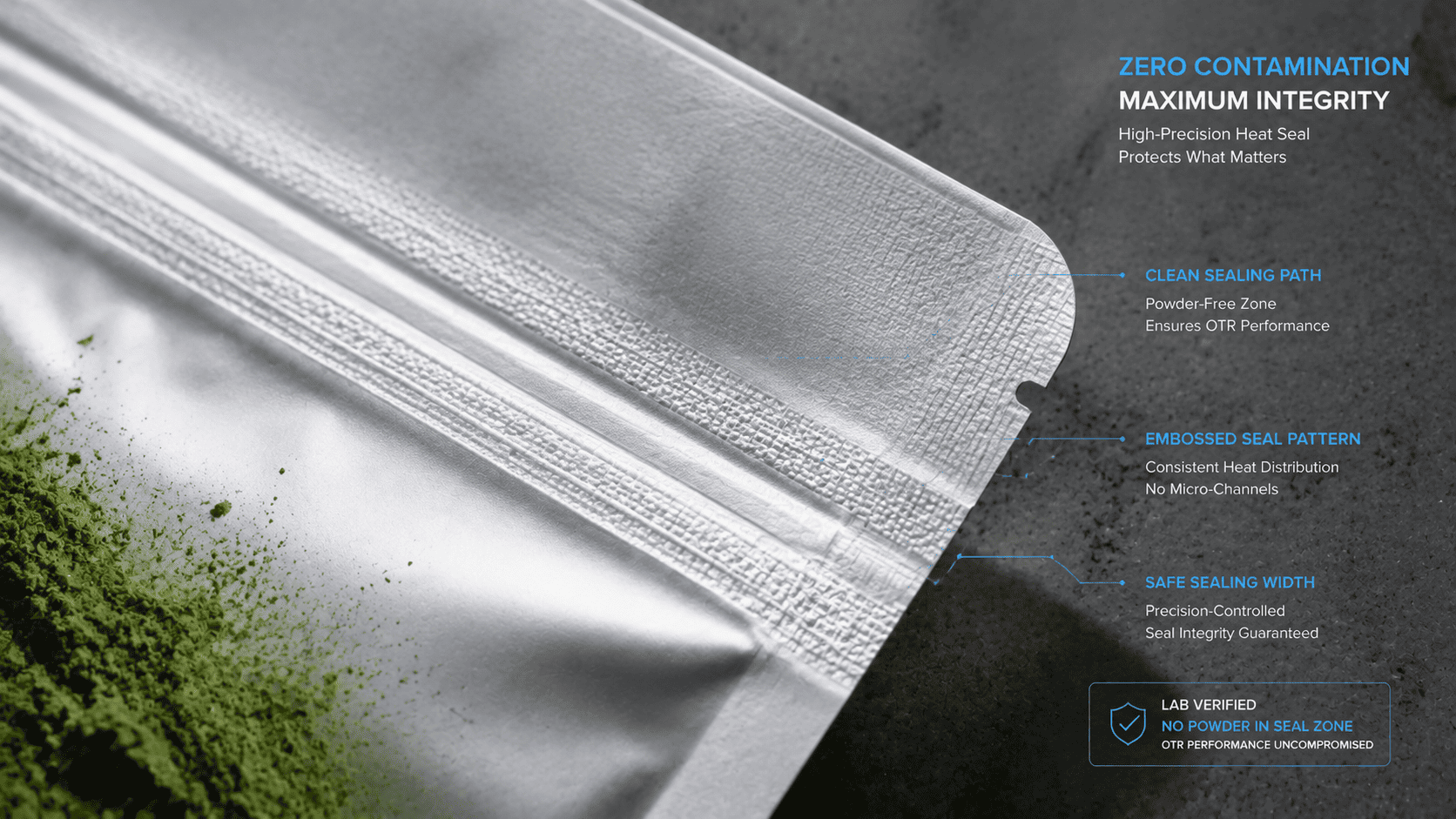
The fine powder has an ability to accumulate in the seal section and develop pathways that do not pass through the film barrier. Control of dust should be near the permanent seal, sealed temperature, sealed pressure and sealed dwell time should be appropriate to the inner layer, and the line speed.
Inspect More Than Seal Appearance.
Even a straight‑looking seal may have a feeble path. Validation may include:
- The seal‑strength test on a sample of an agreed sampling plan.
- Checks on filled pouches‑ leak or integrity.
- Examination of seal zone contamination by powder.
- Post compression checks, transportation and temperature variations.
- Start‑up, middle and end‑of‑run comparisons.
Sample rejected and corrective settings. This transforms sealing into an operator judgement into a repetitive production control.
Check Zippers and Reclosure Individually.
The unopened product is shielded by the permanent top seal and the zipper will affect its exposure once it is opened. A zipper may have some powder stuck in it, which will not reclose. Choose the closure based on the powder behavior, the number of times opened and how the consumer will handle it and not on the appearance.
Fill the test pouches by re‑opening and re‑closing. Record the amount of powder, position of closure and force needed to close the zipper. The description of post‑opening performance should be listed in addition to the unopened shelf‑life claim.
Experiment on the Whole Pouch with respect to Target Shelf Life.
An experimental trial applies the matcha to be used, fill weight, pouch size and packing procedure. Maintain control and document residual oxygen, seal integrity, storage parameters, color and aroma at scheduled times. Comparison can be aided by accelerated work but real‑time samples are significant towards the ultimate commercial claim.
Pre‑Ordering: Set Approval Evidence.
Approval file must specify the laminate, pouch drawing, closure, filling settings, test method and accepted sample. Retest in case of change in the material, the layer thickness, the supplier, zipper, dimensions, filling process or shelf‑life target.
Conclusion
A consistent oxygen barrier pouch of matcha relates material permeation, package integrity and filling controls. Foil, metallized and EVOH‑based structures may be used with various programs in case their data is checked in conditions of interest. The converted pouch and packed product should be approved on final basis with supporting evidence of repeatable sealing and shelf‑life.
FAQ
Is a matcha pouch an airtight zipper as evidence of the presence of an oxygen barrier?
No. Other factors that affect oxygen exposure are the film, permanent seals, folds and initial headspace. The package that has not been opened and that which has been reopened should be evaluated differently.
What is to be checked with an OTR value?
Check: unit, temperature, relative humidity, test method and precise structure of material. When the conditions match, only then compare values.
Do you always need aluminum foil with matcha?
Not always. The necessary structure is dependent on the shelf life, distribution, filling process and acceptable product change. Validated or metallized EVOH based structures can be appropriate in certain programs.
Is nitrogen flushing a substitute of high‑barrier pouch?
No. Flushing decreases the initial oxygen, and the pouch should also restrict subsequent entry, and ensure that the seal remains intact throughout the desired shelf life.
At what time should a matcha pouch be retested?
Retest following modifications of the laminate, supplier, dimensions, closure, sealing process, filling conditions or shelf‑life target.
Post time: Aug-25-2026


