


The moisture barrier packaging to be used in powder should be chosen based on the effect of moisture on the actual product. Fine tea powders, food ingredients, and drink mixes can clump, become unflowable or hard to dose prior to a pouch becoming visibly damaged. A dry product then must have a specification which governs the intrusion of water‑vapour during filling, storage, distribution and re‑use.
Purchasing decision ought to relate product sensitivity, target shelf life, climate and package size to quantifiable barrier performance. An appearance of a thick‑looking film or a material name is not enough. The buyers are expected to inspect WVTR data, entire laminate, and seal integrity and outcomes of filled‑pouch tests conducted under the conditions that reflect the desired market.
Find out What Moisture Does to the Powder.
Start with the failure to be avoided. Other powders will create small lumps and can be used, whereas other powders will cake and become a solid mass, lose aroma or no longer flow through dispensing equipment. Note the initial unacceptable alteration rather than depending on the overall request of a moisture‑proof bag.
Create a Product‑Moisture Profile.
The supplier brief ought to define:
- · Powder type, particle size and target fill weight.
- · Known hygroscopic behavior and desirable clumping level.
- · Anticipated shelf life (before and after opening).
- · Storage, transport and retail humidity conditions.
- · Filling temperature and cooling period, prior to sealing.
Such specifications enable candidate structures to be evaluated based on a single commercial requirement as opposed to competing based on cost or looks.
Separate Liquid‑Water and Separate Water Vapor Exposure.
A pouch can be used to exclude splashes and at the same time allow water vapor to penetrate the film at a slow pace. Related, but distinct, properties are liquid resistance, seal integrity and water‑vapor transmission. The slow moisture gain that cannot be detected during a brief visual examination usually influences powder shelf life.
Indicate that the package should be able to endure the humidity in the warehouse, condensation, or wet handling or a combination of all three. An external water shipping test is not a substitute to a barrier test and a low film WVTR is not a remedy to an open channel in the permanent seal.
Read WVTR In Stated Test Conditions.
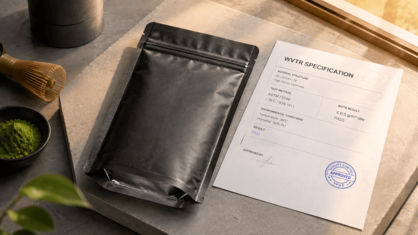
Water Vapor Transmission Rate or WVTR or MVTR is a report of the amount of water vapor that passes through a material in a specified area and duration. Reduced values tend to show increased resistance to moisture. This should include its unit, temperature, relative‑humidity gradient, structure of the specimen and test method.
Comparison Like with Like.
Never compare suppliers with values derived in other climates or on other layers. Check to confirm that the report is the full laminate that will be proposed to be produced. When the methods are not comparable, seek results of requests under a common condition followed by the selection of the lowest‑looking value.
Compare Moisture‑ Barrier Material Direction.
The table is a procurement outline rather than an overall performance rating. Each direction can be altered by the layer grades, thickness, lamination, conversion and test conditions.
| Material direction | Moisture‑barrier role | Key point to be checked. | Suitable purchasing context |
| Aluminum foil laminate | Demanding moisture‑barrier benchmark | Flex‑damage, disposal of seals and laminates. | Sensitive dry or wet, long distribution. |
| Metallized laminate | Flexibility and cost/Balance of barrier. | Consistency of coating and conversion. | Retail and multi‑SKU mainstream programs. |
| PE‑based high‑barrier structure | Recyclable material direction | WVTR, working layers and market claim. | Brands that associate protection and recycling objectives. |
| Basic clear film | Exposure and easy construction. | Fail to comply with sensitive‑powder shelf life. | When filled‑pouch testing is in favor of the target. |
Use Foil to a Demanding Moisture Target.
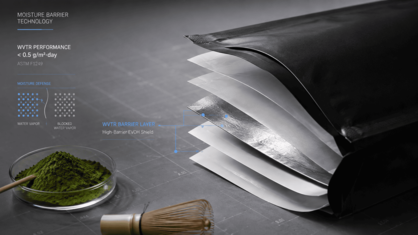
One of the directions that have been proven is the use of aluminum‑foil laminates where a powder that needs high moisture levels, high oxygen and light protection are needed. They can be used on premium matcha, moisture sensitive drink powders or products that travel through the distribution routes that are humid over a long duration.
The pouch is still to be validated. Folds, flexing and bad seals can lead to weak paths which are not in a flat film sample. Check the entire laminate, including consideration of performance and end‑of‑life implications and not acceptance of foil based on the name of the material.
Test Metallized Film to Balanced Performance.
Metallized laminates are able to offer applicable moisture resistance at an alternative cost, weight and flex profile. They can be used in regular retail applications with the shelf‑life target not necessarily demanding the most demanding foil benchmark.
Check Coating and Conversion Consistency.
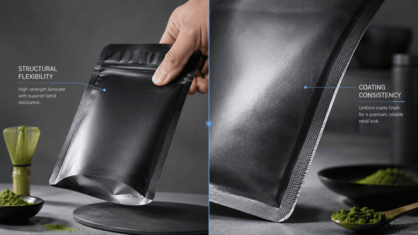
The performance of barrier is a dependent on deposited layer, substrate, adhesive, process of curing and pouch‑forming. The appearance of metals does not reflect a specific WVTR. Ask the proposed structure and check sample representative finished pouches of the planned production route.
Evaluate PE‑High‑Barrier Structures with Caution.
Brands that seek to be recyclable can use mono‑material structures (or mostly PE) whereas coatings or functional layers can be employed to enhance the barrier performance. YPAK provides PE‑based packaging as one of its product directions that can be recycled, such as structures that are used to store food, tea and coffee.
The moisture‑protection claim and recycling claim should be supported by different evidence. Authenticate the destination‑market advice, finished pouch parts and WVTR of the building under quote. Do not use performance data of a different thickness or construction.
Control Moisture Added Prior to Sealing.
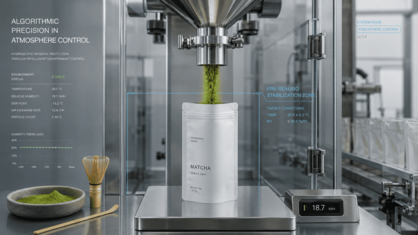
A high barrier is not able to eliminate moisture that is already in the powder or package headspace. The starting condition can be dictated by product temperature, room humidity, exposure time and condensation. Filling trials should thus note the setting and time interval between handling of the product and end sealing.
Do Not Pack until the Product has Stabilized.
The transfer of a warm product or container to a cooler area can cause condensation. Create a relevant step in conditioning and maintain packaging materials in a safe place. The process accepted must be comparable across the shifts and seasons.
Keep Fine Powder Out of the Seal Area.
A channel may develop through the permanent heat seal despite a strong WVTR outcome of the film. The process of filling equipment, dust extraction and pouch handling must minimize the product in the sealing area. The temperature, pressure and dwell time of the seal should be the same as the inner layer and line speed.
Check Seal on Filled Pouches.
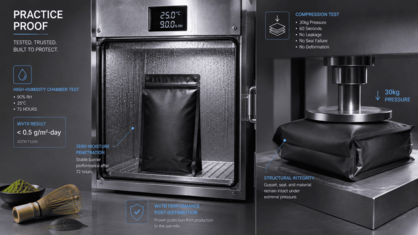
Inspect start‑up, middle and end‑of‑run samples. Apply a combination of seal‑strength, leak or integrity tests that have been agreed on and then storage and compression tests are conducted. Corrective settings and record contamination instead of taking a seal because it looks straight.
Use Reclosure as an Independent Use State.
The unopened item is guarded by the permanent top seal and the zipper has an impact on moisture exposure once it has been used. The fine powder can accumulate in the zip track and not be able to close completely. Test the desired product by repeatedly opening, dispensing and closing.
State whether the shelf‑life statement is before opening or has a limited time of consumer usage. A smaller portion size may at times be more effective than an elaborate closure to a large pouch.
Desiccants Only as a Support that has been tested.
When the capacity, activation and location of a desiccant is appropriate to both the product and headspace, it can be used to support a moisture‑control system. It is not used to fix a leaking seal or use in place of a poor laminate. The needs of consumers and the destination market need to be addressed, too.
Measure Its Contribution
In case of a desiccant suggestion, contrast otherwise identical pouches with and without the desiccant. Measure powder condition and changes due to moisture at pre‑set intervals. This isolates the performance of the sachet and not the performance of the pouch itself.
Test Filled Pouches in Relevant Humidity.
A test run utilizes the targeted powder, fill weight, size, material and sealing procedure. Documented store control and candidate packs. Test mass change where necessary, clumping, flowability, aroma, seal condition and appearance of the package at specified intervals.
Define Before Testing Acceptance
Concur on what constitutes failure prior to opening of samples. The outcome is not a subjective choice as a recorded limit of clumping, dispensing or sensory change is applied to the result. Screening can be supported by accelerated comparison, whereas the final shelf‑life claim should be supported by real‑time samples.
Accept a repeatable Moisture‑Barrier Specification.
The purchase file must specify the entire laminate, the thickness, in the form of a pouch, the dimensions, closure, test conditions and accepted filled sample. Associate these records with target market, shelf life and packing process.
Retest in case of material, supplier, layer thickness, zipper, pouch size, and seal settings changes, or in case of filling environment or distribution climatic changes. Repeat orders need to recreate proven performance as opposed to an imprecise description like thick, premium or moisture proof.
Conclusion
Proper moisture barrier packaging of powder combines the appropriate WVTR information with meticulous filling, clean seals and validation of filled‑pouch. High‑barrier structures made of foil, metallized and PE can be used to fulfill various commercial goals when compared to each other under similar conditions. The chosen pouch must safeguard the actual powder in the distribution and use cycle it is to perform.
FAQ
Will a thick pouch always offer a greater moisture barrier?
No. The performance of barrier relies on the entire material structure, layer properties and conversion quality. Compare data of WVTR at similar test conditions.
What is the information that should be kept with a WVTR value?
Check the unit, temperature, relative‑humidity gradient, test method and correct laminate tested.
Will a zipper render the powder packaging waterproof?
The film and permanent seals regulate the package which has not been opened and a zipper facilitates re‑opening of the package after opening. Complete zipper closure might also be prevented by powder contamination.
Is a desiccant a substitute of moisture‑barrier film?
No. It is able to back a proven system, but is not able to make up a poor laminate or a seal that leaks.
What is the recommended time of moisture‑barrier packaging retesting?
Re‑test following materials, suppliers, pouch size, closures, sealing parameters, filling conditions or desired storage climate.
Post time: Aug-26-2026


