


Food grade powder packaging is a pouch or other pack that has food‑contact materials that are appropriate to the intended product, temperature, contact time and destination market. The term is not applied to a single plastic, laminate or universal certificate. A buyer must be able to get confirmation that the real structure and its parts can be utilized with the definite powder under the conditions suggested.
When it comes to brands that purchase flexible pouches, the conformity should be associated with the product protection and control over the production. The inner sealant, adhesive, inks, barrier layers, closures and manufacture process are all a part of the completed package. The supplied construction should be corresponding to the documents and packed‑pouch trials should guarantee good sealing, cleanliness and trial performance during the packing line.
Define the Powder Before Approving Food Contact.
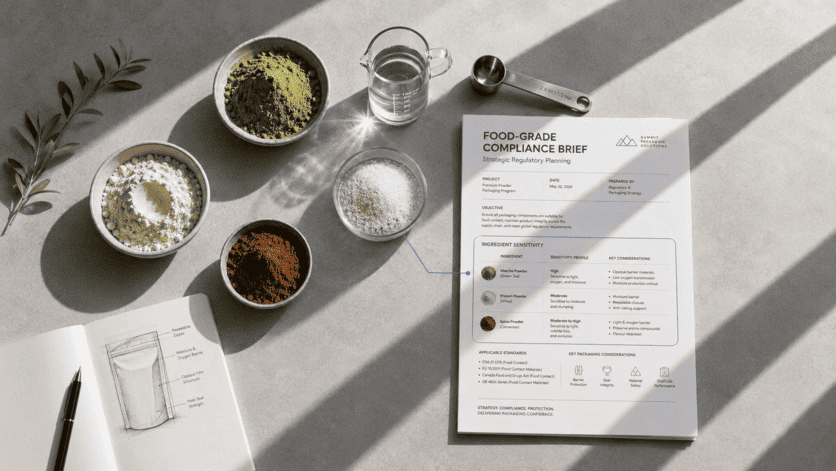
Start with the food and not a description of a generic bag. Matcha and drink mix and spice powder and protein blend and powdered confectionery may vary in the content of oil, aroma, particle size and sensitivity. The effects of these characteristics are on the appropriate contact layer, barrier, seal and migration assessment.
Note the Proposed Conditions of Use.
The supplier brief must mention:
- · Ingredients of the product and the fat, acid or flavor.
- · Fill temperature and cool off of the powder in the pouch.
- · Expected contact time and shelf‑life.
- · Temperatures of storage, transport and consumer‑use.
- · The countries where the following is to be applied and the compliance reviewer.
There should not be any statements about one food or condition that we should give to another. The evidence needs to be satisfactory to the reasonably foreseeable use of the package.
Know What Grade Means to a Pouch.
Food grade should be considered a use‑specific compliance endpoint. It must have the right materials, good production and documentation. This does not mean that all the layers would be in direct contact with the powder, but even the non‑contact layers and components should be considered in the final structure.
Accept an icon, supplier statement or material abbreviation and believe it to be food safe. Ask about the regulation, type of material, product type and conditions, of which the statement is a part. Make sure that the documents are still valid to the structure you are quoting.
Identify all the Layers in the Material Structure.
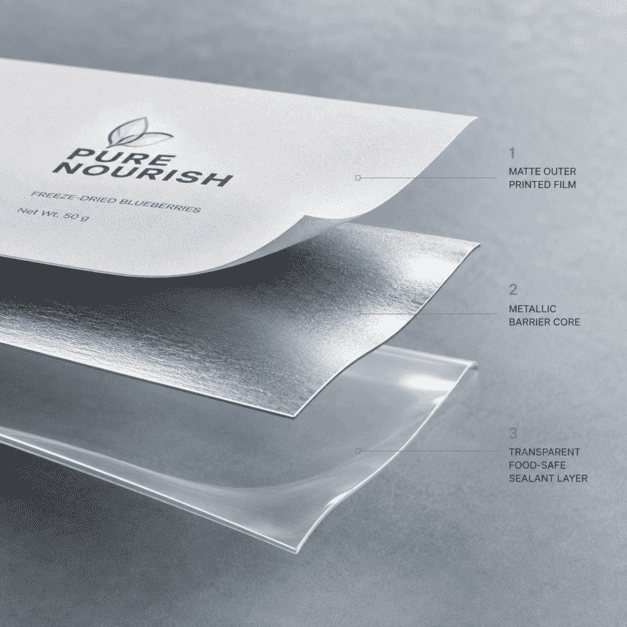
A typical flexible powder pouch is comprised of an outer print substrate, a barrier or structural layer or layers, a adhesive and an inner heat‑seal layer. Depending on the target of protection and presentation, paper, metallized film or aluminum foil can be utilized.
Take note of Food‑Contact Layer.
The seals are created by the inner layer that gets in contact with powder. Its grade of resin, its thickness, additives and sealing range must attain product and packing process. The layer is not admissible on the broad name PE or CPP but the supplier documentation should specify the grade or specification used.
Make up a Food‑Contact Document Checklist.
The following table gives a lifelike buying cycle to the buying groups. The list of documents needed in
| Document or evidence | What to confirm | Common purchasing mistake |
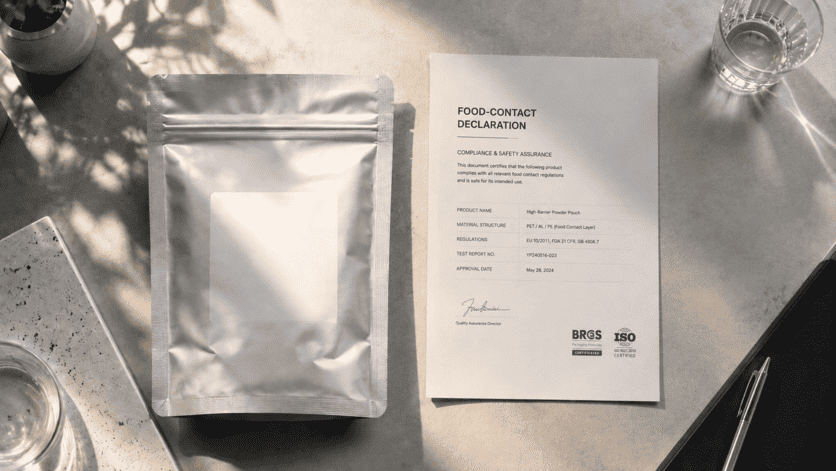
| Food‑contact declaration | Content, market, use and issue date. | Without definition Accepting the term food grade. |
| Migration evidence | Tested contact time and structure, simulant, temperature. | Incorporating terms, which are not related to the powder. |
| Material specification | Thicknesses and contact layer, complete layers. | Superficially looking at the name of the material. |
| Supplier certification | Location, area, authenticity and currency. | Assuming that the entire factories are considered. |
| Traceability record | History: supplier, batch, revision and change history. | The order cannot be associated with documents. |
Assess Suitability of Review Migration Evidence.
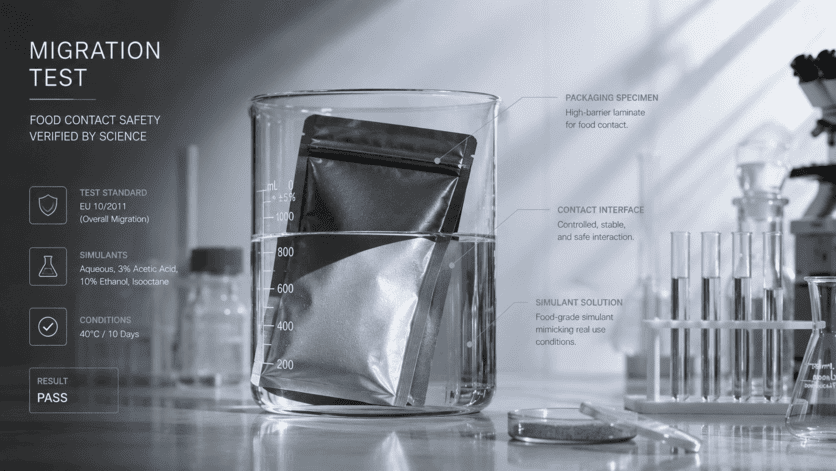
Migration is used to refer to the movement of packaging materials into food. Evaluation can be done on the nature of food, contact time, temperature of packaging surface and ratio of the packaging surface and the food. Testing or supporting evidence then should be the reflection of the intended application as opposed to a convenient unrelated condition.
Test Scope Check.
Check the food simulants, time and temperature, criteria of the result and material tested. Create the laminate on which the report is applied, or to a part. In case of oils in the powder, intense flavor or unusual processing circumstances, request the qualified compliance reviewer to determine the need to have more evidence.
Matches Documentation to Destination Market.
The market specific requirements are food contact requirements. A U.S. project might require an evidence on relevant FDA‑authorised uses whereas an EU project might require a framework, plastics and good‑manufacturing‑practice requirements. Various standards, limits or language requirements can be offered by other nations.
The responsibility of ensuring that the market where the food will be sold has the requirements will be left to the brand but the correct supporting documents must be supplied by the packaging supplier. Do not present one certificate as international assent.
Check Adhesives, Inks and Printed Surfaces.
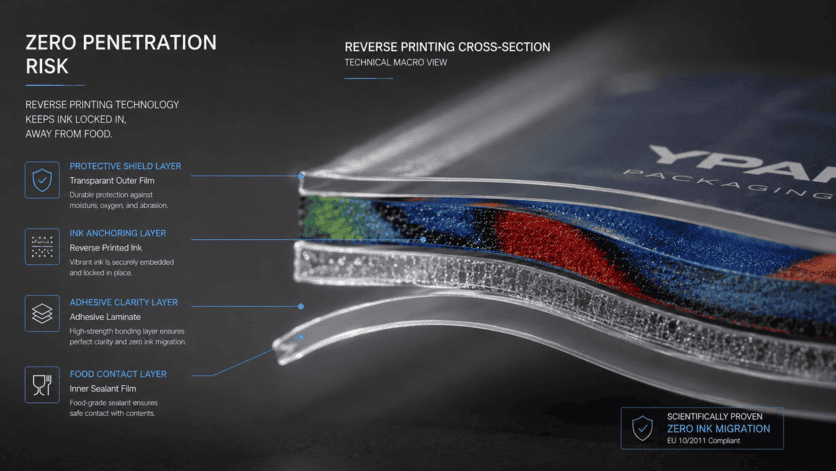
The inside film is not the sole element that needs to be controlled. Lamination adhesives, printing inks, coating and primers are included in the package. The placement of artwork between layers can be performed by reverse printing, but controls in manufacturing are required to control curing, set‑off, residual solvents and unwanted contact.
Keep Artwork Away From the Seal and Product.
Seal zones, tear features and other unprinted areas needed by production should be defined by the dieline. Check transformed on ink transfers, smell and peeling. Special finishes should not be introduced even after the compliance approval without taking into consideration their effects on the documented structure.
Recycled and Recyclable Claims Test.
The end of life path is referred to as recyclable and the source of the material as recycled material. By itself neither of these statements demonstrates food‑contact suitability. A PE‑dominant pouch may be utilized to encourage a recycling objective, but the food‑contact characteristics of the resins, additives, barriers, inks and closures must be demonstrated to be appropriate.
Inquire about the presence of recycled content, where it is found and what approval justifies the planned use of food. Establish the barrier and migration performance destination‑market statement.
Control Hygiene in Pouch Manufacturing.
Inappropriate materials may be spoiled by poor production, storage or handling of the materials. Purchasing review should deal with the aspects of cleanliness, foreign body checks and control, pest control, material segregation, traceability and finished pouch protection prior to delivery.
Supplier System: Review.
YPAK mentions that its plants in Foshan and Dongguan are certified with BRCGS Food Safety and ISO 22000:2018. Buyers are not supposed to cease requesting the up to date documents to their order, verifying their scope and validity, and relating the approved supplier location with the actual production record.

Create the Pouch About Fine‑Powder Filling.
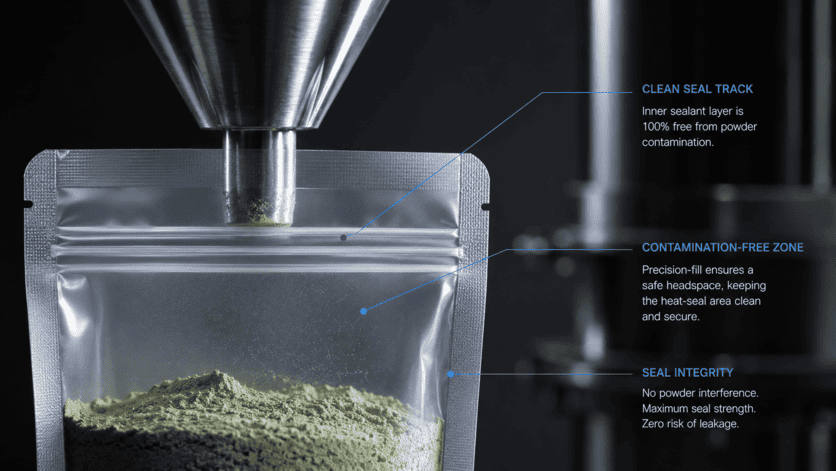
Powdered fine can cause a real‑life situation of creating a static, dust and contamination around the permanent seal. The inner sealant, size and opening of the pouch should be compatible with the filling equipment. Trials should be made with the real powder as an empty pouch will not have dust behavior, filled thickness or Seal Interference.
Confirm Packing Process.
Speed of record filling, seal temperature, pressure and dwell time. Check start‑up, middle and end‑of‑run samples, to verify contamination and integrity. Coding, control checkweighing and rejection control is to be done using the printed pouch and the desired line.
Check Barrier Performance: An Independent Requirement.
Food‑contact compliance never develops oxygen, moisture, aroma or light protection. A legally suitable contact layer may not even meet the goal of the shelf‑life. Check OTR, WVTR, performance on seal and performance of the powder depending on the risks that the powder posed in the product brief.
Individual compliance and performance documents. This makes sure that a food‑contact declaration cannot be relied on as evidence of quality of the barrier and a strong barrier finding cannot be used as evidence of compliance of migration.
Batch and Change Traceability.
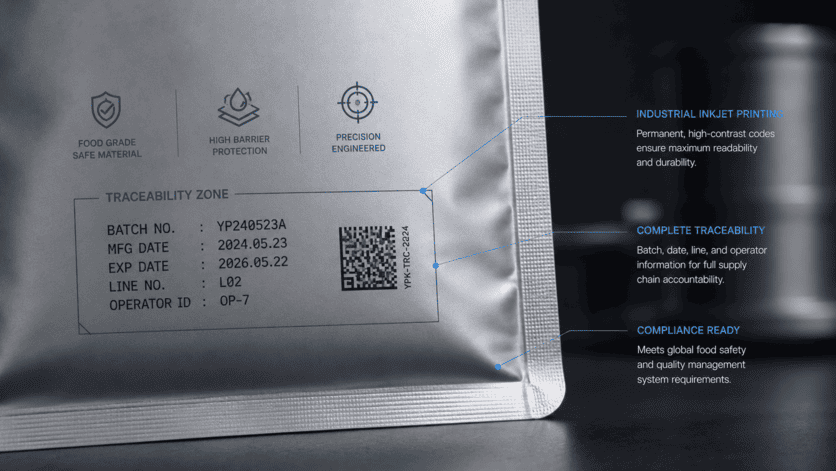
The approved sample, material specification and compliance documents should be associated with purchase orders and production batches. Record the converter, manufacturing site, laminate code, revision and date. This is information that facilitates a complaint or regulatory review to be investigated.
Require Change Notification
Establish what needs to be reviewed prior to production, such as grade of resin, film supplier, adhesive, ink system, coating, thickness of layers, site of closure or manufacture. A pouch which appears identical may not have the same compliance evidence due to an undocumented change.
Approve the Food Grade Powder Pouch.
Document review and a representative converted sample and packing trial should be combined to final approval. Confirm dimensions, construction, odor, appearance, seal integrity, coding and performance of filled‑pouch. Resolve document gaps before bulk production as compared to when the inventory that is to be printed is already printed.
Retest or obtain new evidence, where there is a change, in the product or intended use, material structure, supplier, place or destination‑market demand manufacture. Have the final approval file as repeat orders.
Conclusion
The intended use and the final product which is traceable finished pouch is the beginning of a reliable food grade powder packaging. The buyer is to know all the material layers, examine the market‑related migration and food‑contact evidence, quality control manufacturing hygiene and test the package on the actual filling line. Both compliance and barrier performance are imperative but need to be proved.
FAQ
Does it have food grade approval of the pouch to all powders?
No. It varies based on the product, contact time, temperature, processing conditions and destination market.
What is the normal layer of pouch with which the powder is in contact?
Seals are typically created by the inner layer of heat‑seal that is in direct contact but the overall construction and all of the parts are yet to be examined.
What is a food‑contact declaration? Is it a test of migration?
No. One of the declarations can be compliance within its scope and the evidence of migration can be used to assess in given circumstances. Buyers ought to examine the relationship of the documents.
Do recyclable packaging have to be food grade?
No. The recyclability and food‑contact suitability claims are two independent claims to be established by other evidence.
Frequency of additional food grade powder package inspection?
Check it upon alterations to the food, the purpose of use, structure of material, and supplier of the components, place of production or destination‑market needs.
Post time: Aug-26-2026


